Youtube Podcasts
Youtube Podcasts
A Podcasting Feature for Youtube Music
Role
Research UX Design UI Design
Tools
Figma, Notion, Photoshop, Screen Studio, Jitter
Timeline
100 Hours




Based on user research and testing Youtube Podcasts seeks to:
return to the simple and straightforward principles of a feed like Google Podcasts
create playlist-focused listening filters based on user needs and desires.
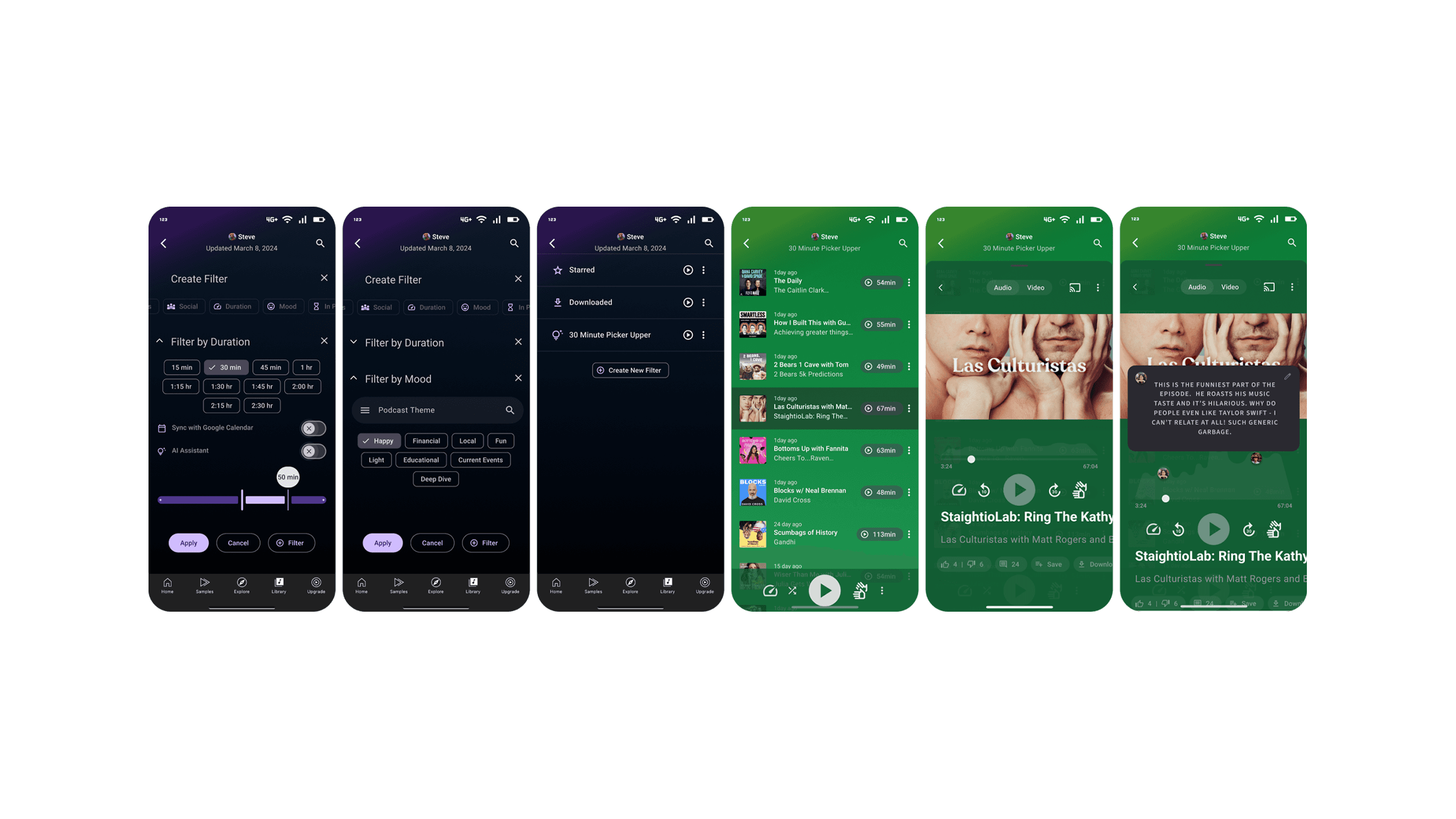
filter by mood, friend recommendations, and time increment-based listening for multitasking
foster social tools that are light, fun, and non-toxic because users ultimately find podcasts through their friends
incorporate simple ways for podcasters to monetize further through the platform to incentivize and promote creativity
Based on user research and testing Youtube Podcasts seeks to:
return to the simple and straightforward principles of a feed like Google Podcasts
create playlist-focused listening filters based on user needs and desires.
filter by mood, friend recommendations, and time increment-based listening for multitasking
foster social tools that are light, fun, and non-toxic because users ultimately find podcasts through their friends
incorporate simple ways for podcasters to monetize further through the platform to incentivize and promote creativity
Based on user research and testing Youtube Podcasts seeks to:
return to the simple and straightforward principles of a feed like Google Podcasts
create playlist-focused listening filters based on user needs and desires.
filter by mood, friend recommendations, and time increment-based listening for multitasking
foster social tools that are light, fun, and non-toxic because users ultimately find podcasts through their friends
incorporate simple ways for podcasters to monetize further through the platform to incentivize and promote creativity
Podcast users are frustrated with the clutter and bloat of music streaming platforms. Can we make podcast listening better?
Background
Google Podcasts to Youtube Music
In consolidating the product with its music streaming platform Google is transitioning to the Spotify model. However, users lament integrated music/podcast platforms for being bloated and cluttered.Background
There are Other Great Options
Well-loved options, Pocket Casts and Over Cast, maintain niche audiences drawn by their well-attuned designs.
Problem
Standing Out
Google does not have a unique product offering compared to other market leaders; Youtube Music is offering a similar player as Spotify and Apple.Problem
Integration
How does this incorporate with Youtube Music in a way that is not a mess? Music/podcast platforms are often doing too much all at once (does music streaming have the same needs as podcasting?).Problem
Payments
Podcasters are looking to the subscription payment models which will require sort of integration. On the music streaming side artists are suffering from lack of monetization of their product.
Goals
Winning through Simplicity
The goal is to create a simple, fun, and straightforward library feature that caters to serious podcast listeners and casuals alike separate of music streaming.Goals
It will draw on the strengths of the previous platform and creates a unique joyful listening experience.
C. Challenge
About Google Podcasts and the Landscape
Google Podcasts is being sunseted and its users are being directed to Youtube Music. Its users appreciated the straightforward and simple design, the ability to work across platforms, and the light loading times.
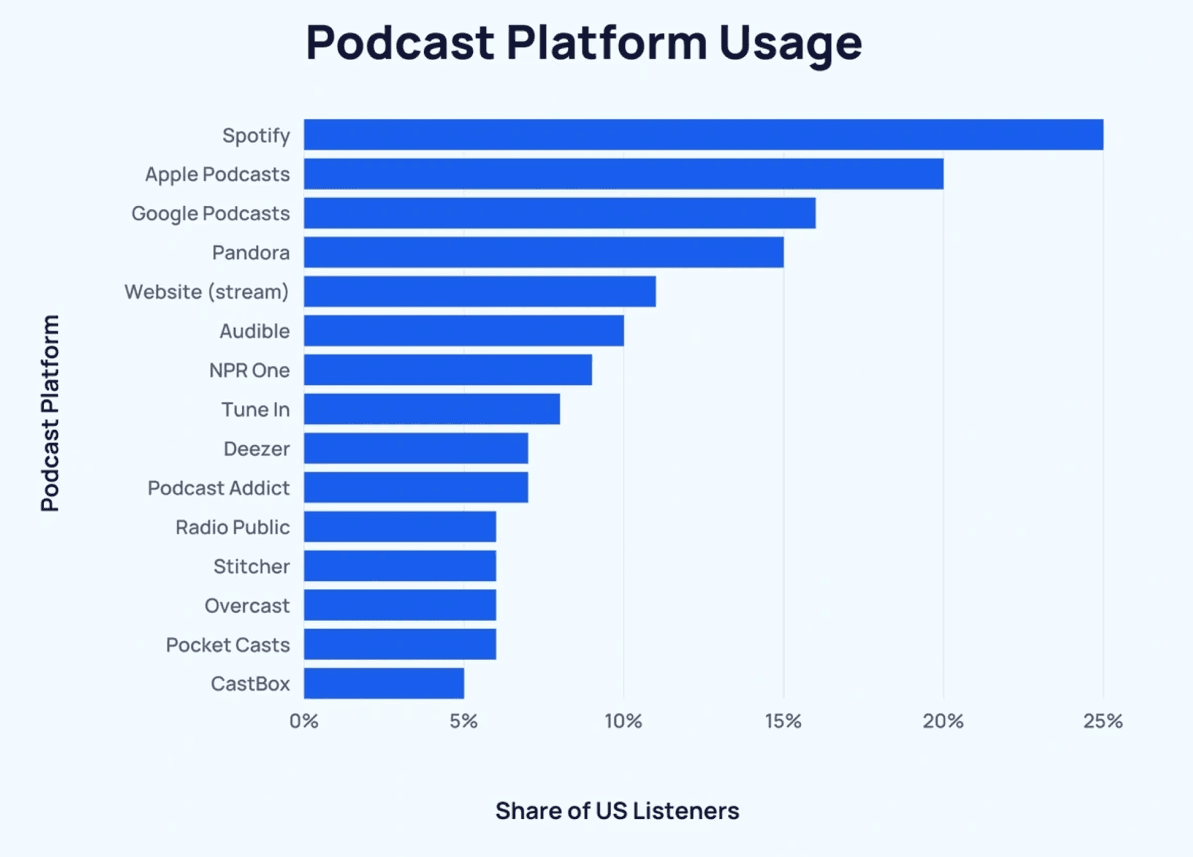
Simultaneously, users of Spotify, the 1# platform, are dissatisfied with the product offerings. Can we work to capture these users?About Youtube Music Integration
The challenge of this project is working within the existing design of YouTube Music. Google Podcasts was unique among the top three podcasting platforms; it was dedicated to podcast streaming and was simple and straightforward. It garnered a dedicated audience.YouTube Music is a different beast. It closely mirrors the Spotify experience inheriting its pluses and minuses.
We may ask ourselves:
Can Google Podcasts' uniqueness be incorporated into the new platform?
Can improvements be made to both inherited designs?
How can YouTube Music stand out from its competitors to achieve the number one spot?
Inspiration
Along with Google Podcasts, several smaller podcast platforms are popular. What can be learned from these competitors?
Pocketcasts and Overcast stray from the Spotify mold to introduce a simplified, customizable interface that users love.
Similarly, Spotify Radio, a short-lived colorful streaming product, offered unique, playful, and intuitive interactions that were deeply inspiring. Its simplicity and ease of use were its main attractions.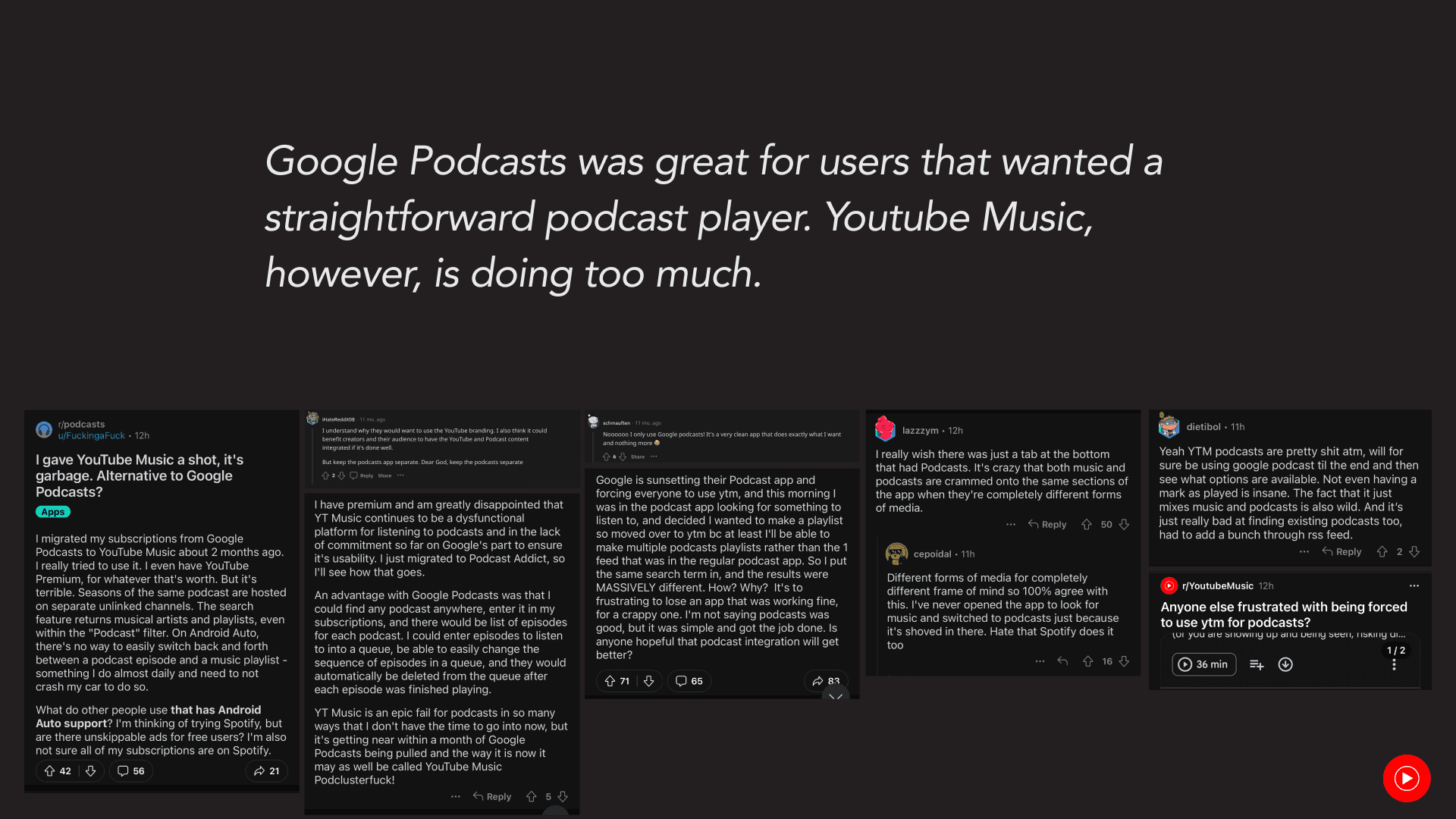
About Google Podcasts and the Landscape
Google Podcasts is being sunseted and its users are being directed to Youtube Music. Its users appreciated the straightforward and simple design, the ability to work across platforms, and the light loading times.
Simultaneously, users of Spotify, the 1# platform, are dissatisfied with the product offerings. Can we work to capture these users?About Youtube Music Integration
The challenge of this project is working within the existing design of YouTube Music. Google Podcasts was unique among the top three podcasting platforms; it was dedicated to podcast streaming and was simple and straightforward. It garnered a dedicated audience.YouTube Music is a different beast. It closely mirrors the Spotify experience inheriting its pluses and minuses.
We may ask ourselves:
Can Google Podcasts' uniqueness be incorporated into the new platform?
Can improvements be made to both inherited designs?
How can YouTube Music stand out from its competitors to achieve the number one spot?
Inspiration
Along with Google Podcasts, several smaller podcast platforms are popular. What can be learned from these competitors?
Pocketcasts and Overcast stray from the Spotify mold to introduce a simplified, customizable interface that users love.
Similarly, Spotify Radio, a short-lived colorful streaming product, offered unique, playful, and intuitive interactions that were deeply inspiring. Its simplicity and ease of use were its main attractions.
01. Discover
The goal of this phase is to gather insights from potential users to inform the development. To do this we conducted user interviews, in-depth competitive assessment, and user testing.
User Interviews
Conduct in-depth interviews with 5 participants to gather qualitative insights. Explore their podcast listening habits, challenges faced, and expectations from a podcast platform. Understand the integration of podcasts in their daily routines.
Competitive Assessment
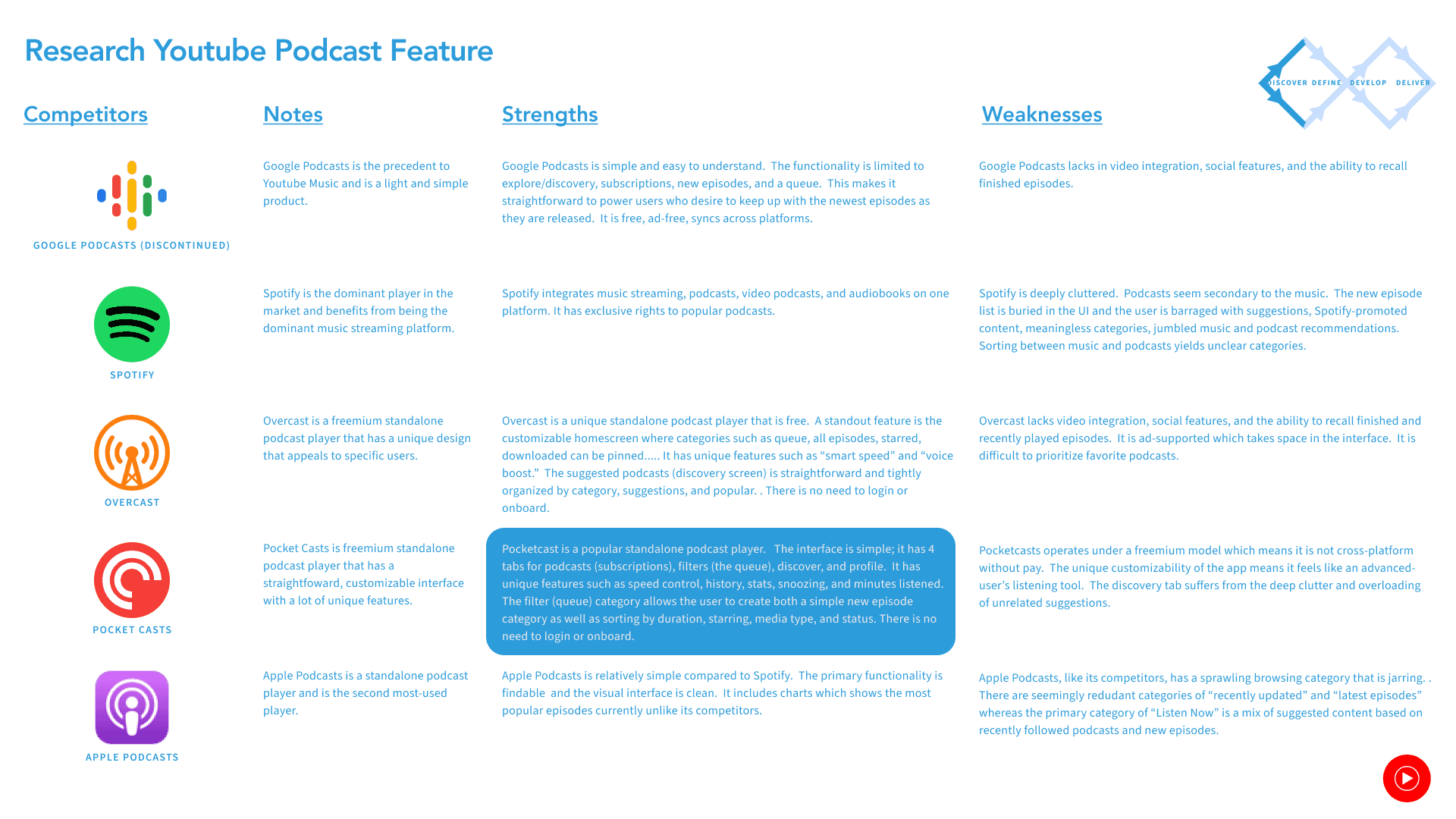
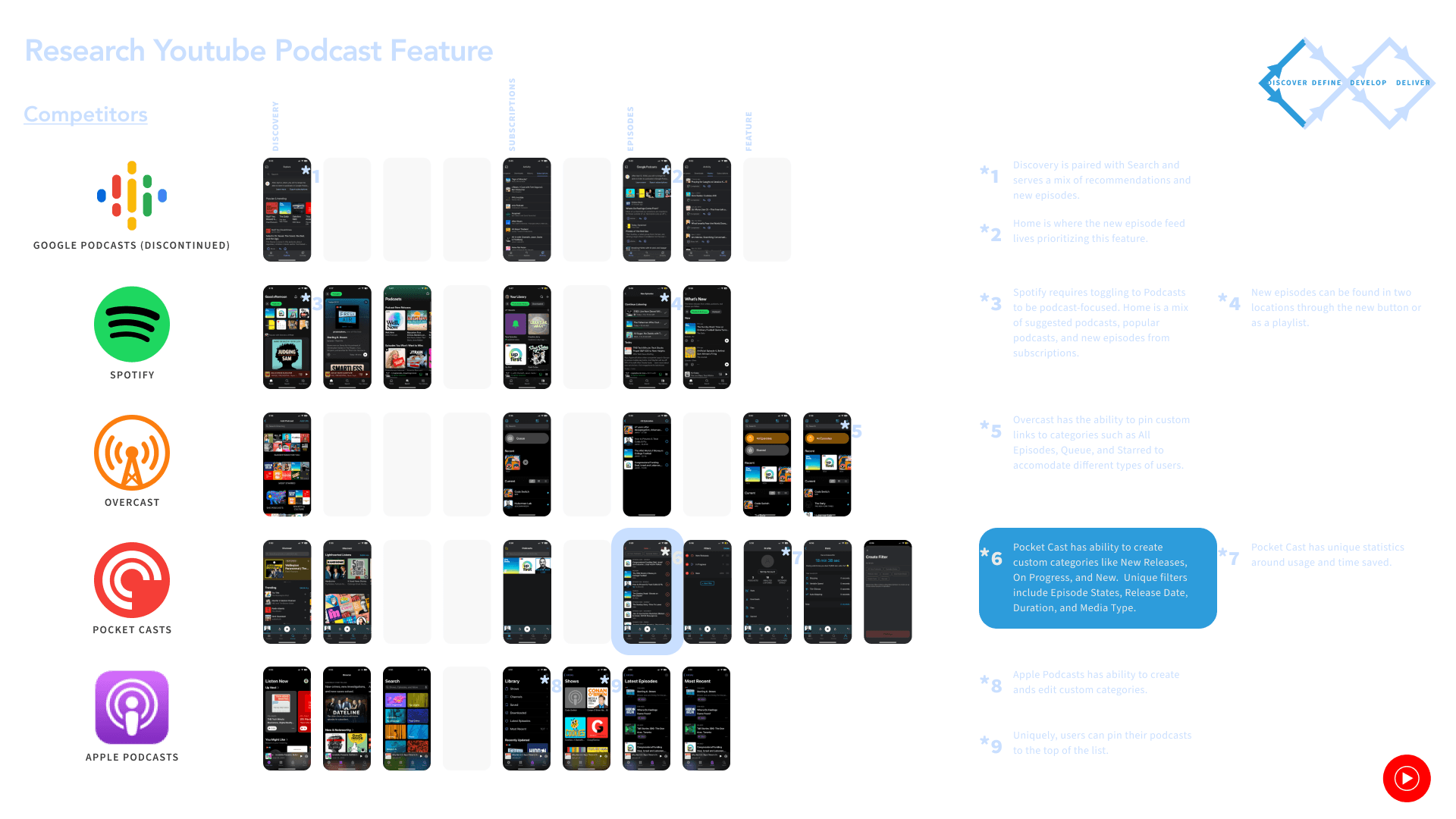
Conduct an audit of the best platforms, the current Youtube Music, and the defunct Google Podcasts platform
01. Discover
The goal of this phase is to gather insights from potential users to inform the development. To do this we conducted user interviews, in-depth competitive assessment, and user testing.
User Interviews
Conduct in-depth interviews with 5 participants to gather qualitative insights. Explore their podcast listening habits, challenges faced, and expectations from a podcast platform. Understand the integration of podcasts in their daily routines.
Competitive Assessment
Conduct an audit of the best platforms, the current Youtube Music, and the defunct Google Podcasts platform
So what exactly are we trying to determine?
We are trying to determine how people use podcast apps to create a new feature that is fun, unique, and useful to distinguish Youtube Music from other podcast players.
So what exactly are we trying to determine?
We are trying to determine how people use podcast apps to create a new feature that is fun, unique, and useful to distinguish Youtube Music from other podcast players.
Read Further
Read Further
Who is out there doing what we want to do already?
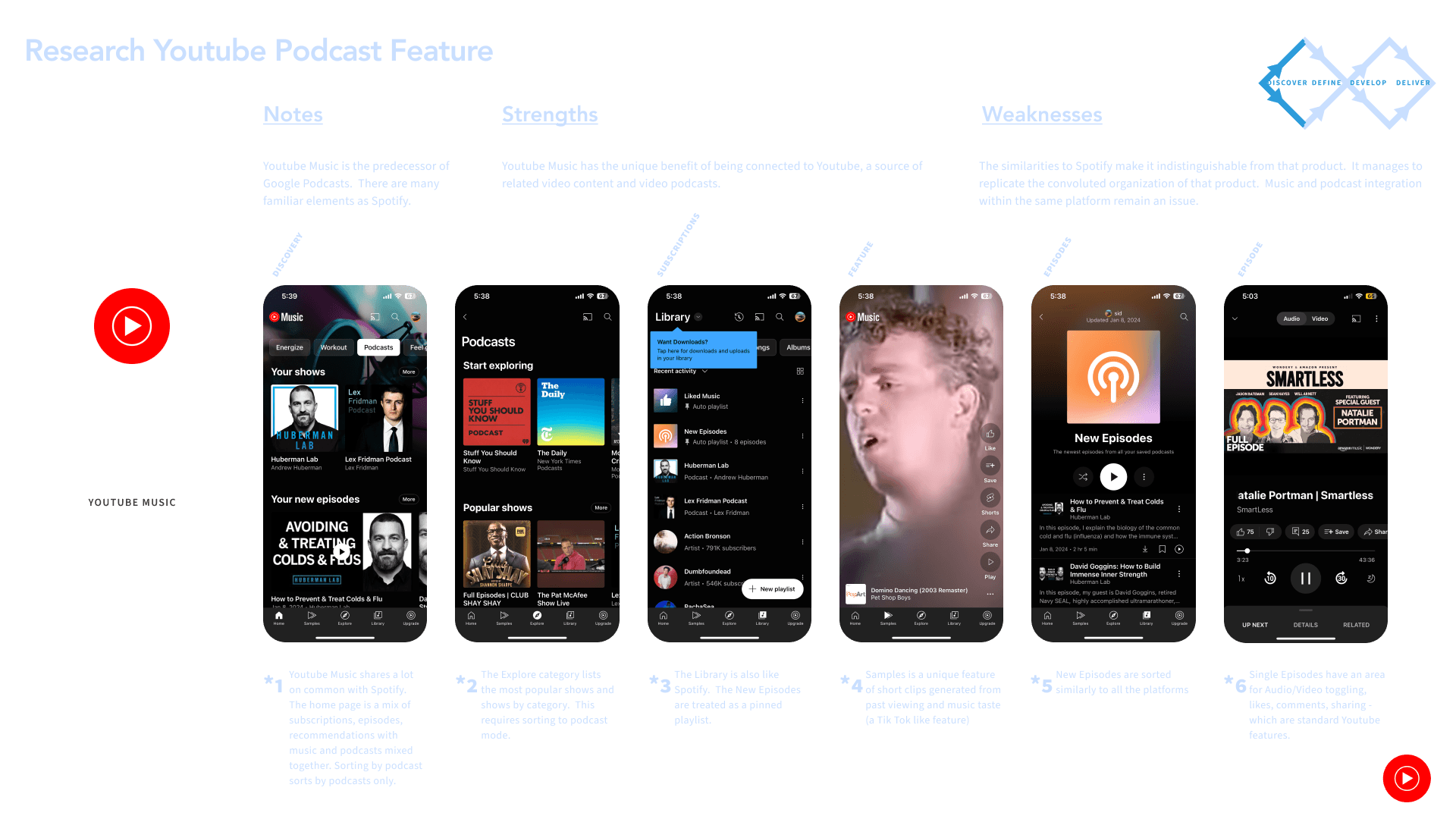
Who is out there doing what we want to do already?
Read Further
Read Further
02. Define
Now, armed with answers to our questions we synthesized the information. We understand common issues and identify the problems to be explored. What aspects of this do we explore?
02. Define
Now, armed with answers to our questions we synthesized the information. We understand common issues and identify the problems to be explored. What aspects of this do we explore?
Multitasking Mindset
Listening to podcasts happens while multitasking - in transit, commuting, walking, cleaning, cooking, and working, for example.
Basic Queuing is a Painpoint
Basic queuing for new episodes frustrated all interviewed users. Users of Apple Podcasts all had difficulty with the standard queuing mechanics.
Personal Reccomendations Drive Listening
Users cited personal recommendations as the main source of discovery
Focus is High
Despite multitasking, users are generally highly focused on what they are listening to and paying a lot of attention.
Media Fatigue is a Painpoint
Users of experience fatigue and sense of being overwhelmed by the number of podcasts they follow.
Following interviews we used affinity mapping to find commonalities and organize information trends. What were common issues that multiple interviewees experienced?
Multitasking Mindset
Listening to podcasts happens while multitasking - in transit, commuting, walking, cleaning, cooking, and working, for example.
Focus is High
Despite multitasking, users are generally highly focused on what they are listening to and paying a lot of attention.
Basic Queuing is a Painpoint
Basic queuing for new episodes frustrated all interviewed users. Users of Apple Podcasts all had difficulty with the standard queuing mechanics.
Media Fatigue is a Painpoint
Users of experience fatigue and sense of being overwhelmed by the number of podcasts they follow.
Personal Reccomendations Drive Listening
Users cited personal recommendations as the main source of discovery
Following interviews we used affinity mapping to find commonalities and organize information trends. What were common issues that multiple interviewees experienced?
After finding the trends, themes, and commonalities how do we use this information? We need to generate problems to answer through design:
A HMW (How Might We...) is a question that allows designers to reframe their problem statement for efficient, targeted and innovative ideation.
POV
Podcast listeners need low attention/alternative attention controls because listening is a secondary activity ...How might we help podcast listeners find and sort podcasts simply and quickly with minimal attention?
HMW
How might we help podcast listeners find and sort podcasts with minimal attention
POV
Podcast listeners need thematic categories because listening can be driven by mood
HMW
How might we help podcast listeners sort by different categories?
POV
Podcast listeners need a simple low-commitment way to casually support creators
HMW
How might we help listeners support the podcaster economy better?
POV
Podcast listeners need obvious feeds and queueing because existing queuing logic is unclear and frustrating.
HMW
How might we help podcast listeners sort episodes logically to meet their expectations
POV
Podcast listeners need trusted podcast recommendations because there is low acceptance of generalized recommendations
HMW
How might we help podcast listeners overcome barriers of trust to receive quality recommendations?
POV
Podcast listeners need to sort and pair episodes with activities/increments of time because they listen only while multitasking
HMW
How might we help podcast listeners pair episodes with activities better?
POV
Podcast listeners need low attention/alternative attention controls because listening is a secondary activity ...How might we help podcast listeners find and sort podcasts simply and quickly with minimal attention?
HMW
How might we help podcast listeners find and sort podcasts with minimal attention
POV
Podcast listeners need thematic categories because listening can be driven by mood
HMW
How might we help podcast listeners sort by different categories?
POV
Podcast listeners need a simple low-commitment way to casually support creators
HMW
How might we help listeners support the podcaster economy better?
POV
Podcast listeners need obvious feeds and queueing because existing queuing logic is unclear and frustrating.
HMW
How might we help podcast listeners sort episodes logically to meet their expectations
POV
Podcast listeners need trusted podcast recommendations because there is low acceptance of generalized recommendations
HMW
How might we help podcast listeners overcome barriers of trust to receive quality recommendations?
POV
Podcast listeners need to sort and pair episodes with activities/increments of time because they listen only while multitasking
HMW
How might we help podcast listeners pair episodes with activities better?
POV
Podcast listeners need low attention/alternative attention controls because listening is a secondary activity ...How might we help podcast listeners find and sort podcasts simply and quickly with minimal attention?
HMW
How might we help podcast listeners find and sort podcasts with minimal attention
POV
Podcast listeners need thematic categories because listening can be driven by mood
HMW
How might we help podcast listeners sort by different categories?
POV
Podcast listeners need a simple low-commitment way to casually support creators
HMW
How might we help listeners support the podcaster economy better?
POV
Podcast listeners need obvious feeds and queueing because existing queuing logic is unclear and frustrating.
HMW
How might we help podcast listeners sort episodes logically to meet their expectations
POV
Podcast listeners need trusted podcast recommendations because there is low acceptance of generalized recommendations
HMW
How might we help podcast listeners overcome barriers of trust to receive quality recommendations?
POV
Podcast listeners need to sort and pair episodes with activities/increments of time because they listen only while multitasking
HMW
How might we help podcast listeners pair episodes with activities better?
POV
Podcast listeners need low attention/alternative attention controls because listening is a secondary activity ...How might we help podcast listeners find and sort podcasts simply and quickly with minimal attention?
HMW
How might we help podcast listeners find and sort podcasts with minimal attention
POV
Podcast listeners need thematic categories because listening can be driven by mood
HMW
How might we help podcast listeners sort by different categories?
POV
Podcast listeners need a simple low-commitment way to casually support creators
HMW
How might we help listeners support the podcaster economy better?
POV
Podcast listeners need obvious feeds and queueing because existing queuing logic is unclear and frustrating.
HMW
How might we help podcast listeners sort episodes logically to meet their expectations
POV
Podcast listeners need trusted podcast recommendations because there is low acceptance of generalized recommendations
HMW
How might we help podcast listeners overcome barriers of trust to receive quality recommendations?
POV
Podcast listeners need to sort and pair episodes with activities/increments of time because they listen only while multitasking
HMW
How might we help podcast listeners pair episodes with activities better?
After finding the trends, themes, and commonalities how do we use this information? We need to generate problems to answer through design:
A HMW (How Might We...) is a question that allows designers to reframe their problem statement for efficient, targeted and innovative ideation.
POV
Podcast listeners need low attention/alternative attention controls because listening is a secondary activity ...How might we help podcast listeners find and sort podcasts simply and quickly with minimal attention?
HMW
How might we help podcast listeners find and sort podcasts with minimal attention
POV
Podcast listeners need thematic categories because listening can be driven by mood
HMW
How might we help podcast listeners sort by different categories?
POV
Podcast listeners need a simple low-commitment way to casually support creators
HMW
How might we help listeners support the podcaster economy better?
POV
Podcast listeners need obvious feeds and queueing because existing queuing logic is unclear and frustrating.
HMW
How might we help podcast listeners sort episodes logically to meet their expectations
POV
Podcast listeners need trusted podcast recommendations because there is low acceptance of generalized recommendations
HMW
How might we help podcast listeners overcome barriers of trust to receive quality recommendations?
POV
Podcast listeners need to sort and pair episodes with activities/increments of time because they listen only while multitasking
HMW
How might we help podcast listeners pair episodes with activities better?
POV
Podcast listeners need low attention/alternative attention controls because listening is a secondary activity ...How might we help podcast listeners find and sort podcasts simply and quickly with minimal attention?
HMW
How might we help podcast listeners find and sort podcasts with minimal attention
POV
Podcast listeners need thematic categories because listening can be driven by mood
HMW
How might we help podcast listeners sort by different categories?
POV
Podcast listeners need a simple low-commitment way to casually support creators
HMW
How might we help listeners support the podcaster economy better?
POV
Podcast listeners need obvious feeds and queueing because existing queuing logic is unclear and frustrating.
HMW
How might we help podcast listeners sort episodes logically to meet their expectations
POV
Podcast listeners need trusted podcast recommendations because there is low acceptance of generalized recommendations
HMW
How might we help podcast listeners overcome barriers of trust to receive quality recommendations?
POV
Podcast listeners need to sort and pair episodes with activities/increments of time because they listen only while multitasking
HMW
How might we help podcast listeners pair episodes with activities better?
POV
Podcast listeners need low attention/alternative attention controls because listening is a secondary activity ...How might we help podcast listeners find and sort podcasts simply and quickly with minimal attention?
HMW
How might we help podcast listeners find and sort podcasts with minimal attention
POV
Podcast listeners need thematic categories because listening can be driven by mood
HMW
How might we help podcast listeners sort by different categories?
POV
Podcast listeners need a simple low-commitment way to casually support creators
HMW
How might we help listeners support the podcaster economy better?
POV
Podcast listeners need obvious feeds and queueing because existing queuing logic is unclear and frustrating.
HMW
How might we help podcast listeners sort episodes logically to meet their expectations
POV
Podcast listeners need trusted podcast recommendations because there is low acceptance of generalized recommendations
HMW
How might we help podcast listeners overcome barriers of trust to receive quality recommendations?
POV
Podcast listeners need to sort and pair episodes with activities/increments of time because they listen only while multitasking
HMW
How might we help podcast listeners pair episodes with activities better?
POV
Podcast listeners need low attention/alternative attention controls because listening is a secondary activity ...How might we help podcast listeners find and sort podcasts simply and quickly with minimal attention?
HMW
How might we help podcast listeners find and sort podcasts with minimal attention
POV
Podcast listeners need thematic categories because listening can be driven by mood
HMW
How might we help podcast listeners sort by different categories?
POV
Podcast listeners need a simple low-commitment way to casually support creators
HMW
How might we help listeners support the podcaster economy better?
POV
Podcast listeners need obvious feeds and queueing because existing queuing logic is unclear and frustrating.
HMW
How might we help podcast listeners sort episodes logically to meet their expectations
POV
Podcast listeners need trusted podcast recommendations because there is low acceptance of generalized recommendations
HMW
How might we help podcast listeners overcome barriers of trust to receive quality recommendations?
POV
Podcast listeners need to sort and pair episodes with activities/increments of time because they listen only while multitasking
HMW
How might we help podcast listeners pair episodes with activities better?
Armed with a number user issues we created archetypal user personas to embody our discoveries.
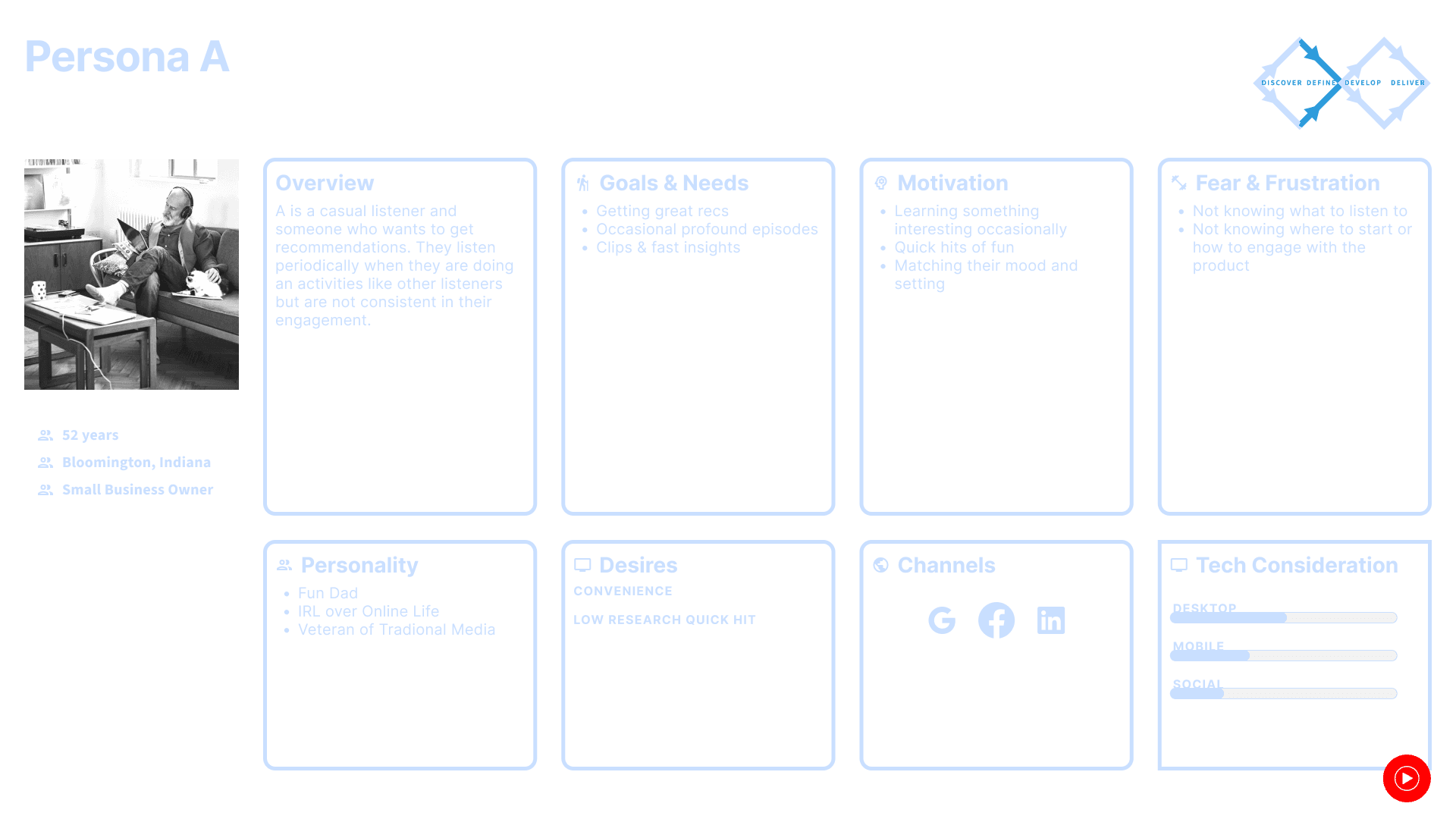
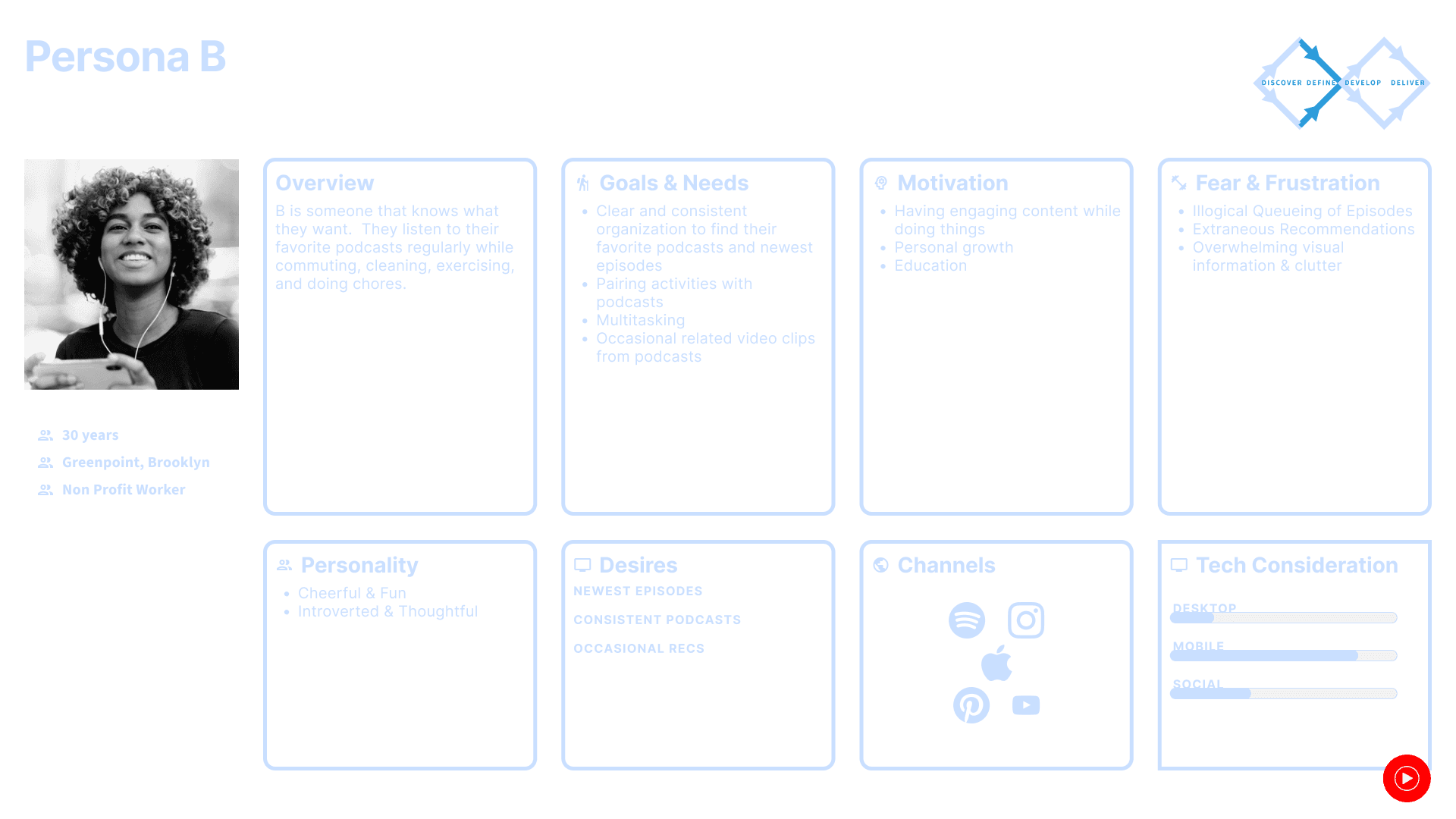
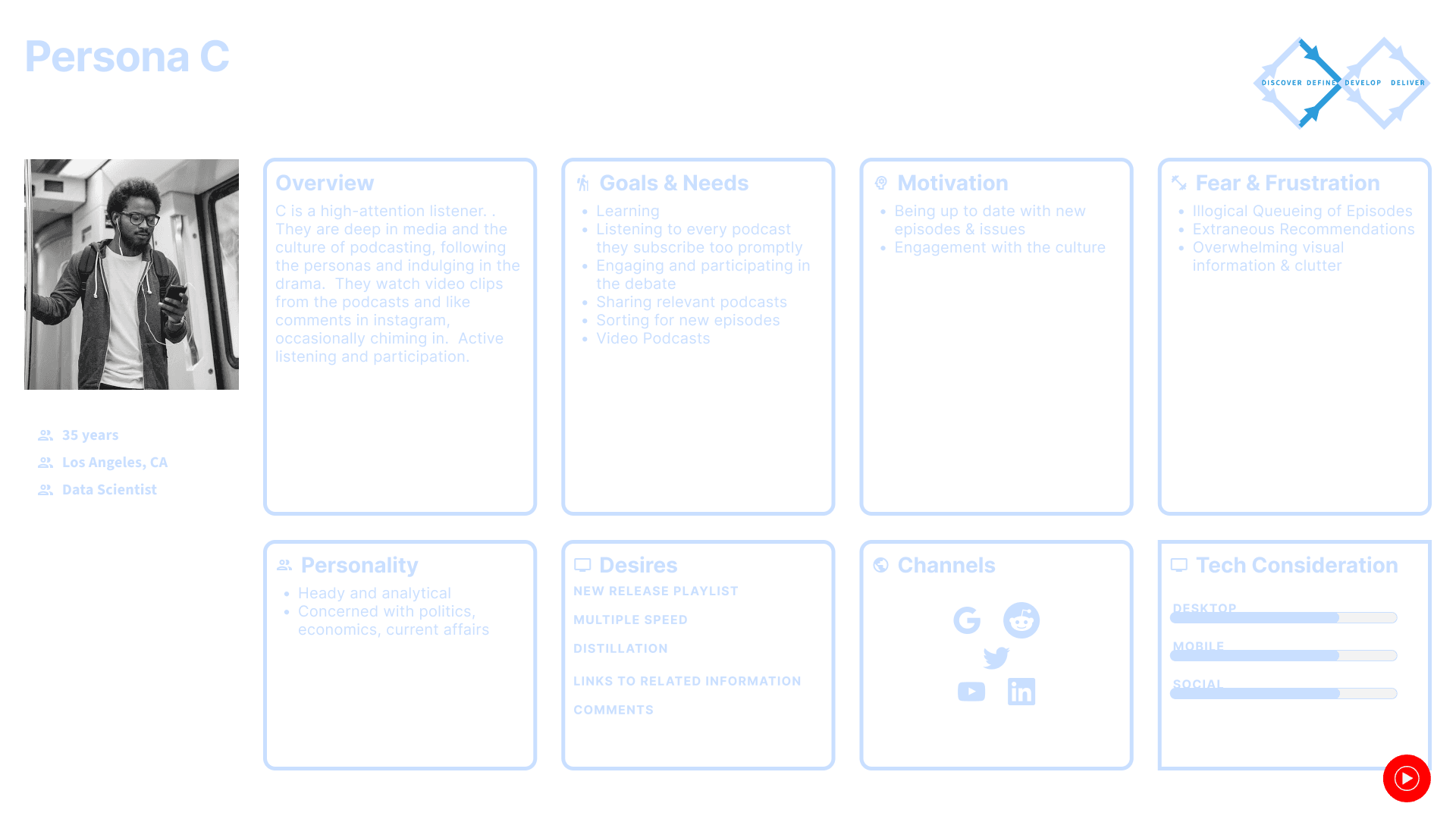
Armed with a number user issues we created archetypal user personas to embody our discoveries.
03. Develop
Project Background
The research indicated common pain points related to the queuing new podcasts. Similarly, users across the board listened to podcasts as a background and multitasking activity with minimal interest in the video. Despite all of this, they are deeply engaged and focused while listening.
03. Develop
Project Background
The research indicated common pain points related to the queuing new podcasts. Similarly, users across the board listened to podcasts as a background and multitasking activity with minimal interest in the video. Despite all of this, they are deeply engaged and focused while listening.
The Lo-Fi Wireframes are quick iterations to outline the taskflow and tie it into the interface.
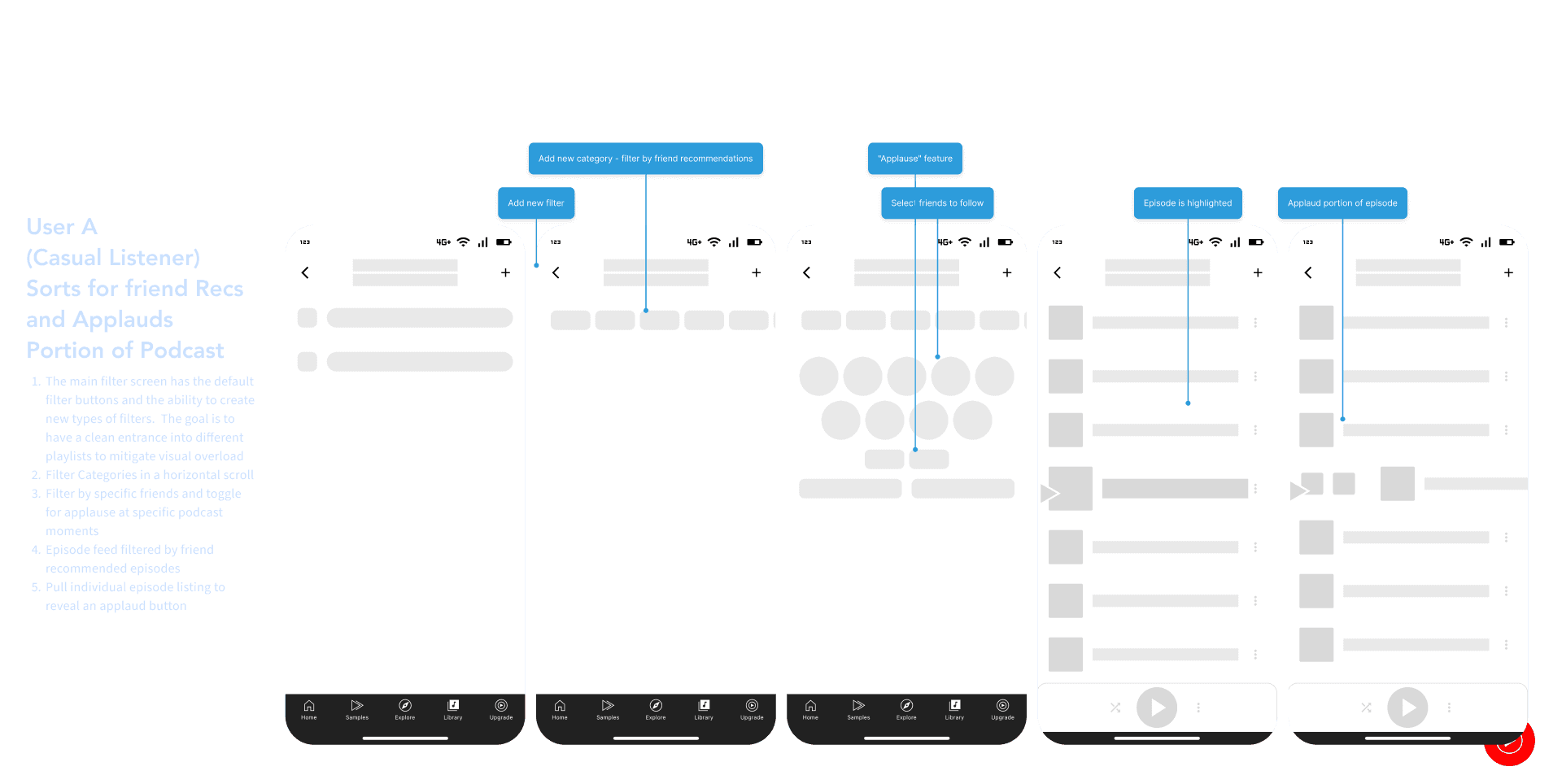
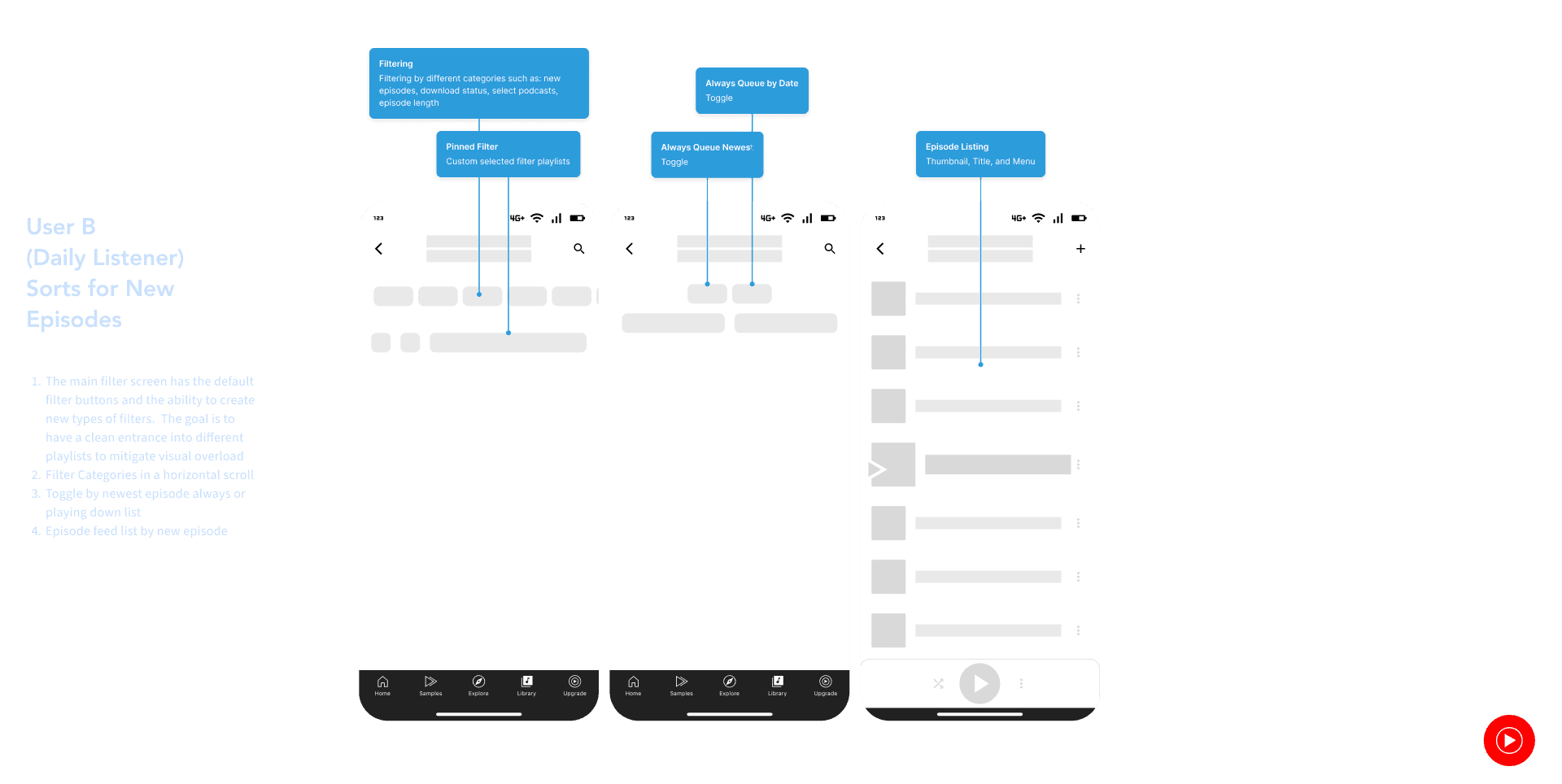
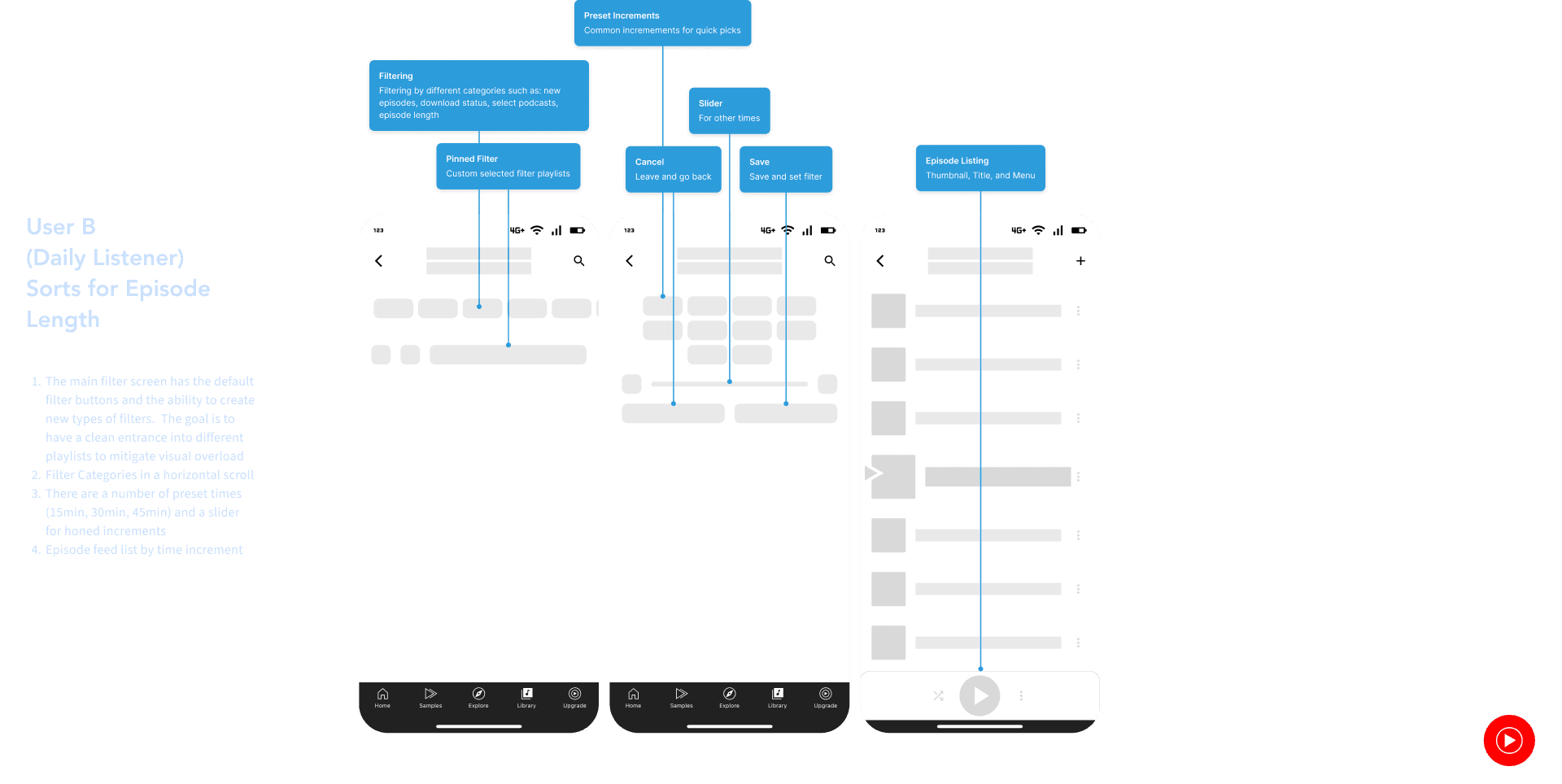
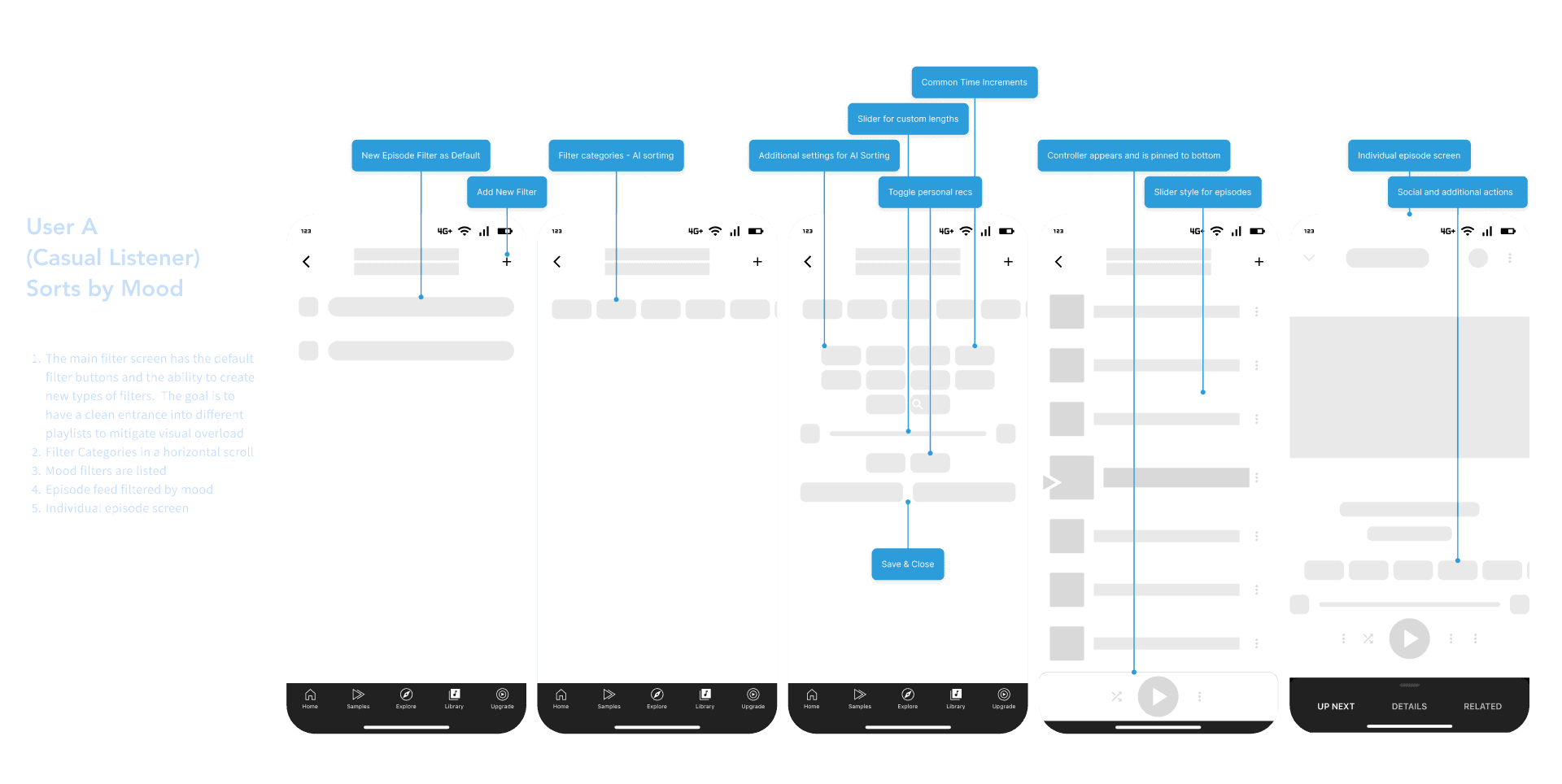
The Lo-Fi Wireframes are quick iterations to outline the taskflow and tie it into the interface.
Further refinement meant incorporating UI kit of parts into wireframes.
How do we deploy the UI standards of Youtube Music/Google?
Do we find strategic moments to break from their standards to improve on their designs?
How do the brand colors incorporate into the UI?
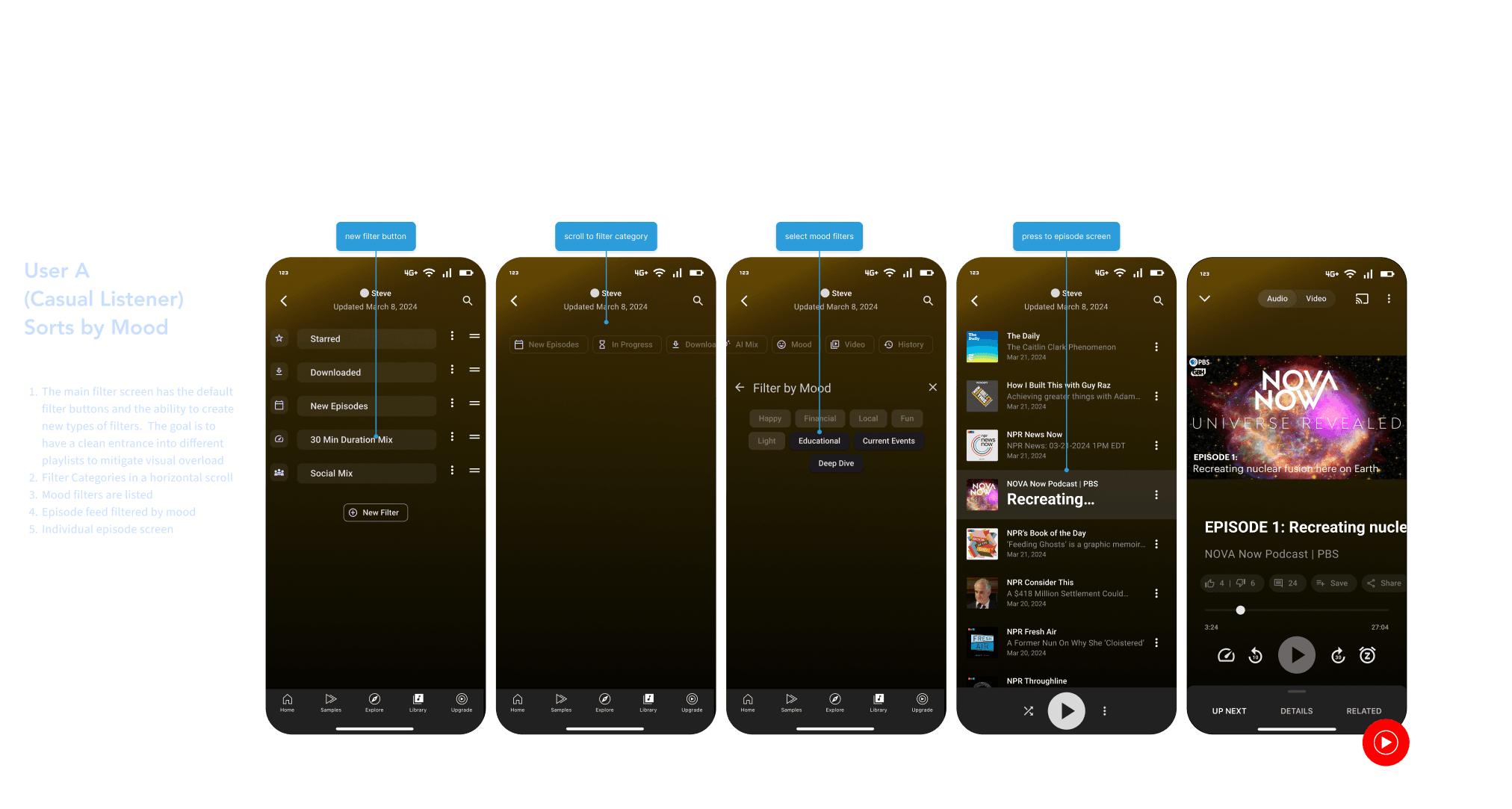
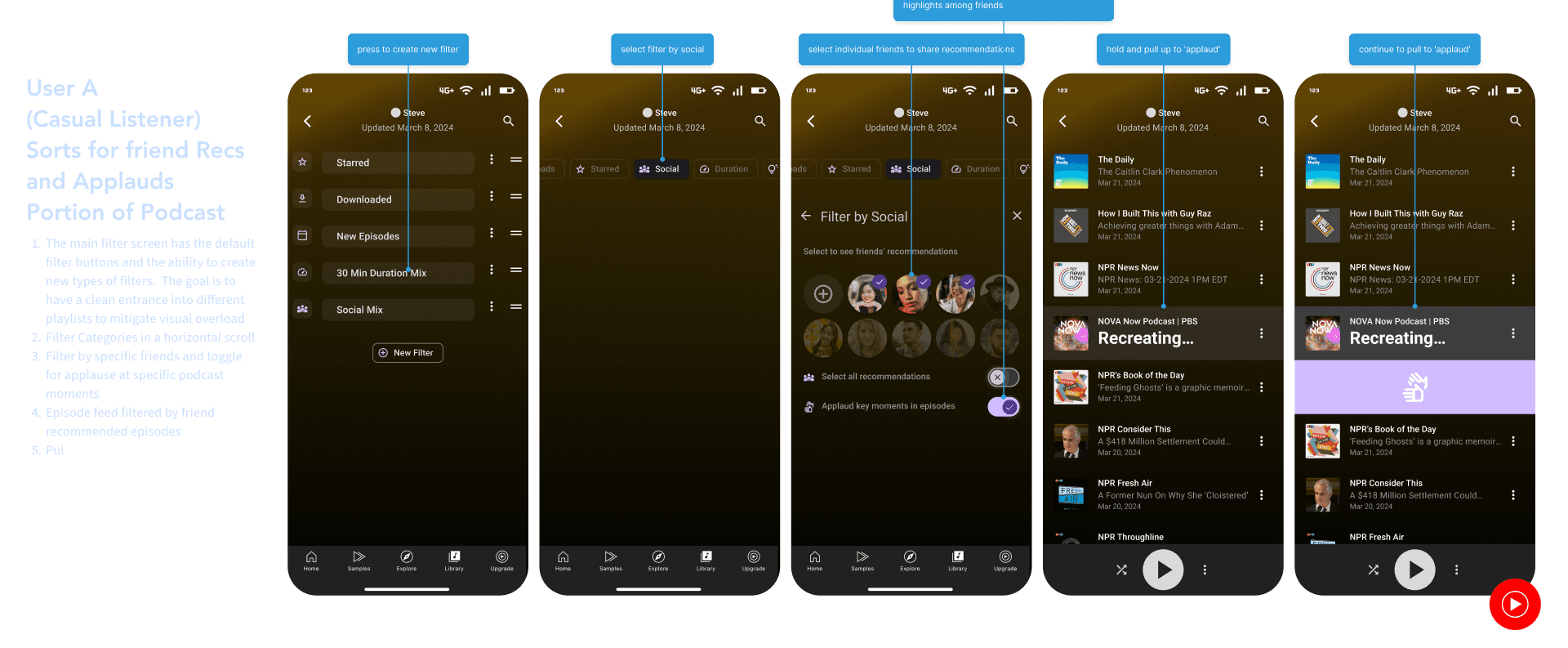
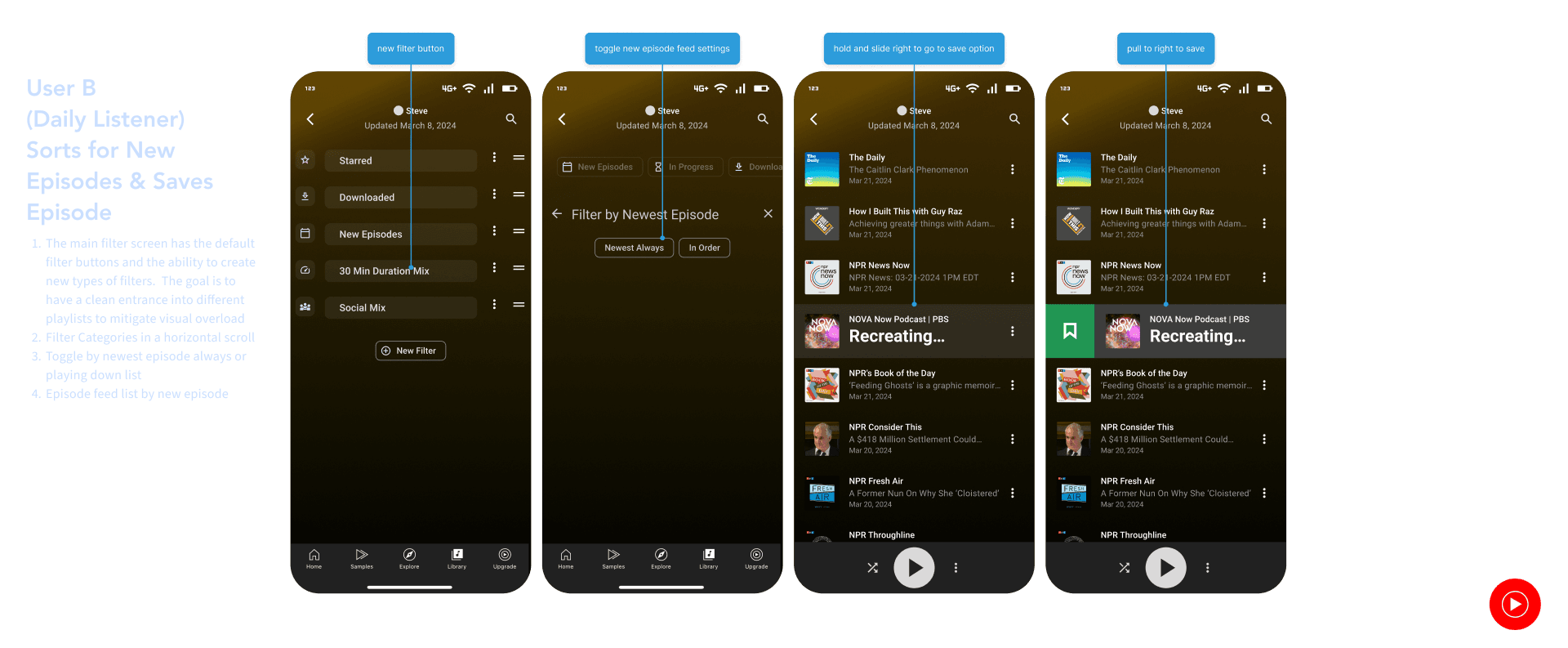
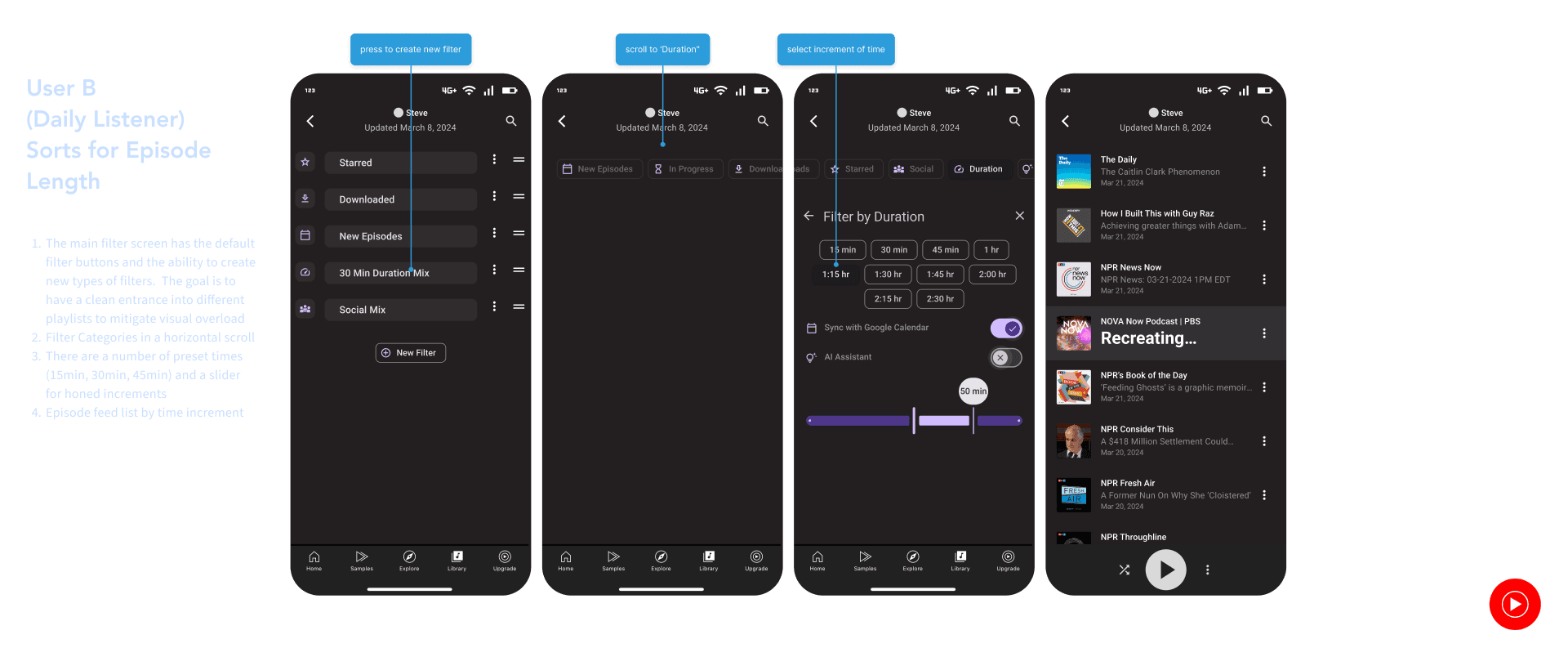
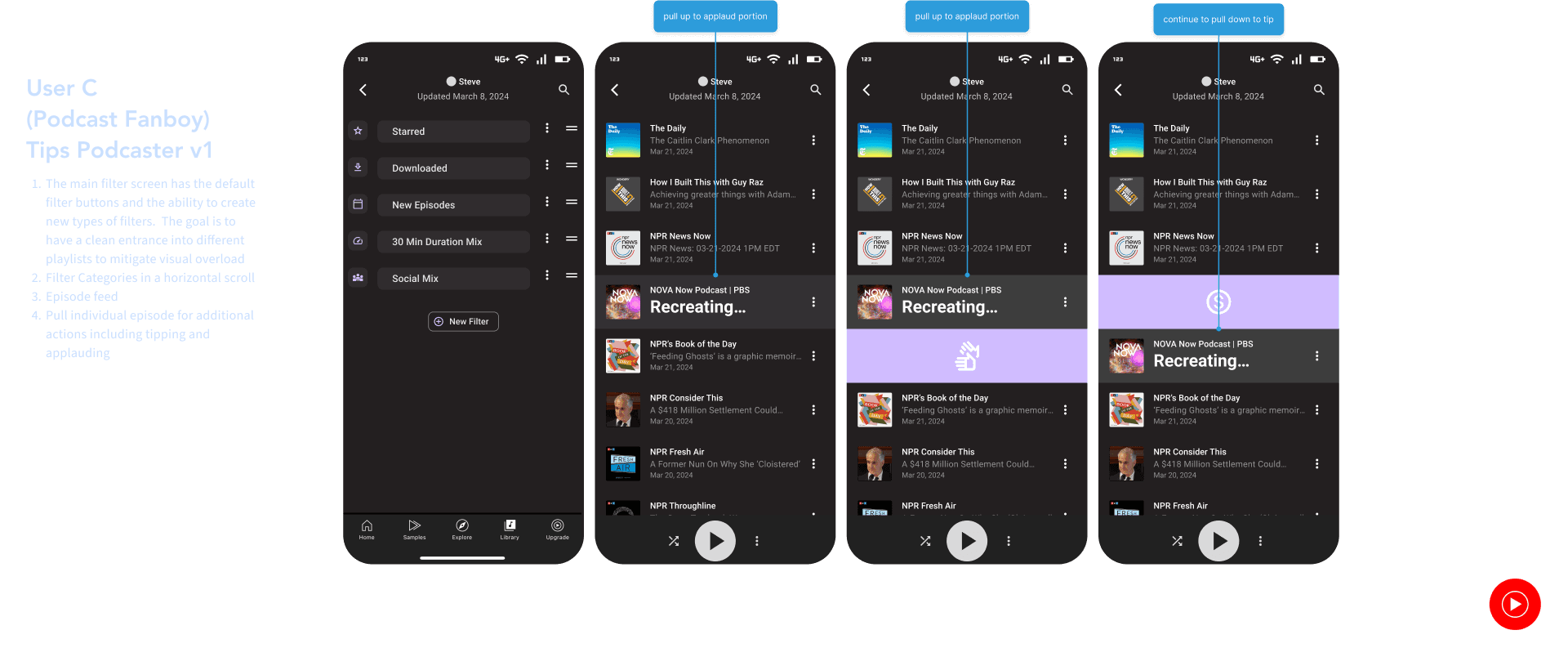
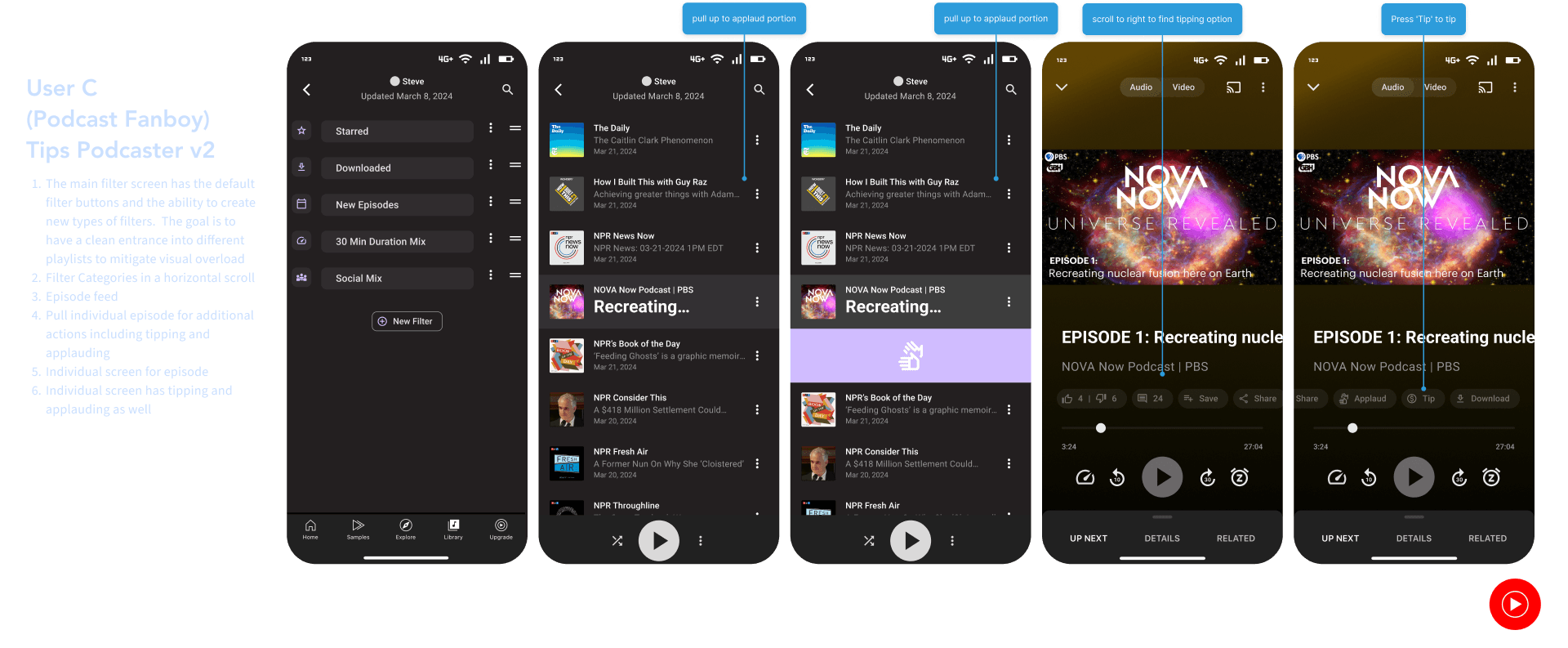
Further refinement meant incorporating UI kit of parts into wireframes.
How do we deploy the UI standards of Youtube Music/Google?
Do we find strategic moments to break from their standards to improve on their designs?
How do the brand colors incorporate into the UI?
04. Deliver
This phase of the design process involved deploying a prototype and challenging my design assumptions. Where were we wrong? Also, what did I fail to anticipate when this was deployed?
04. Deliver
This phase of the design process involved deploying a prototype and challenging my design assumptions. Where were we wrong? Also, what did I fail to anticipate when this was deployed?
To user test we developed a prototype of the proposed podcasting feature. We proceeded to conduct usability testing sessions with participants to assess the intuitiveness, functionality, and overall user experience. Afterward, we collected feedback on specific features, navigation, and any potential issues.
With a prototype in hand participants were asked to complete 4 taskflows while being observed. Participants were asked to think outloud in realtime while performing the tasks and reflect on their expectations. The amount of time and points of failure were denoted.
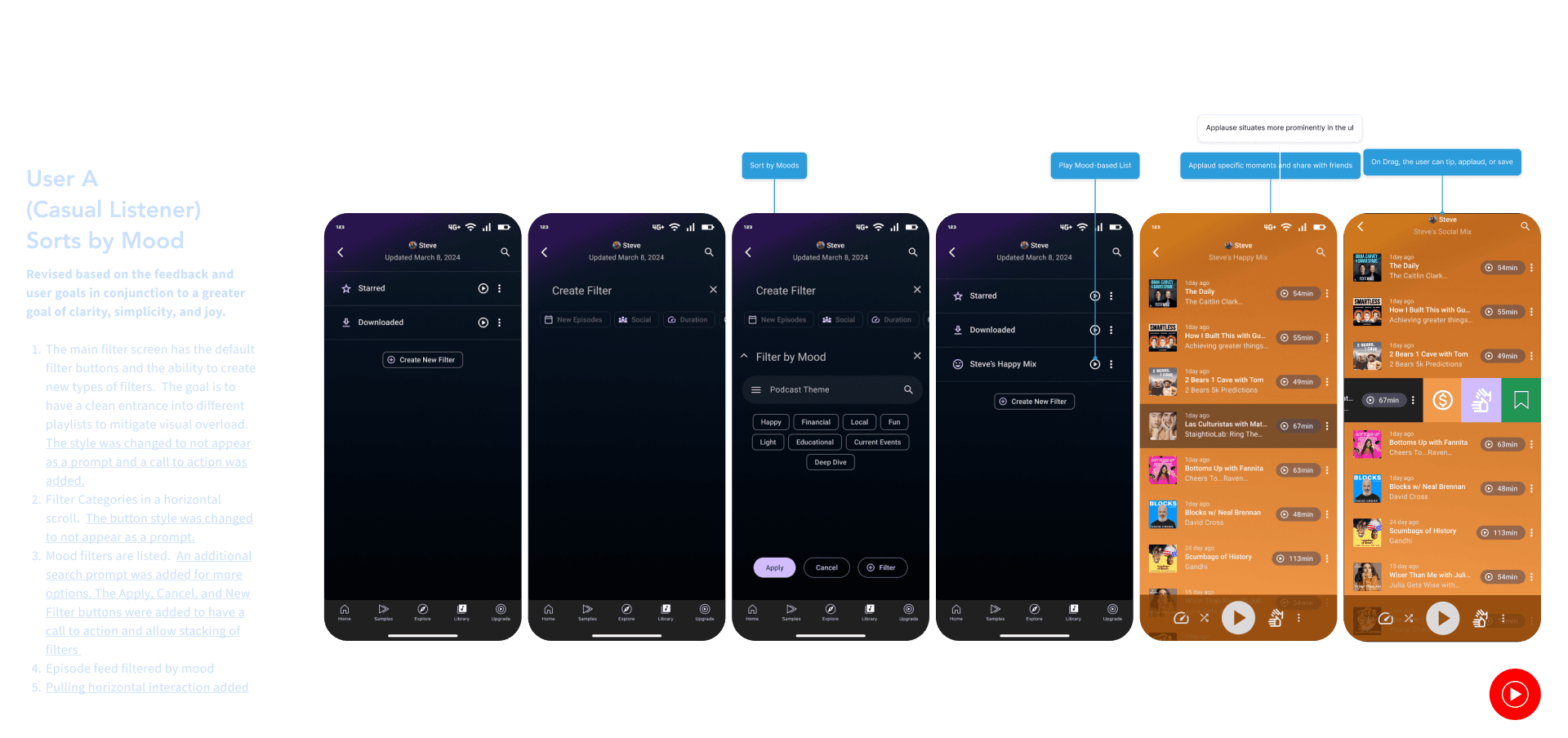
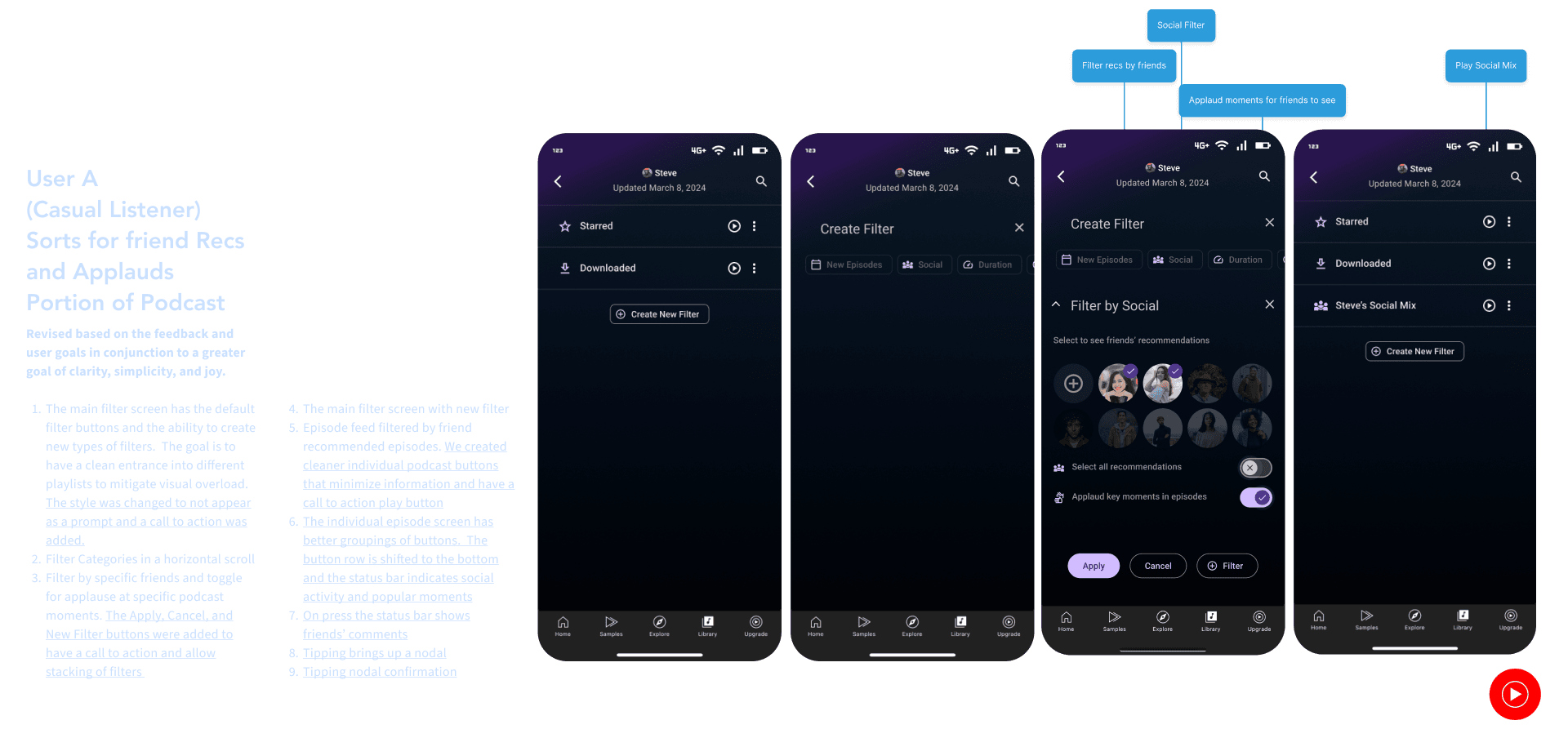
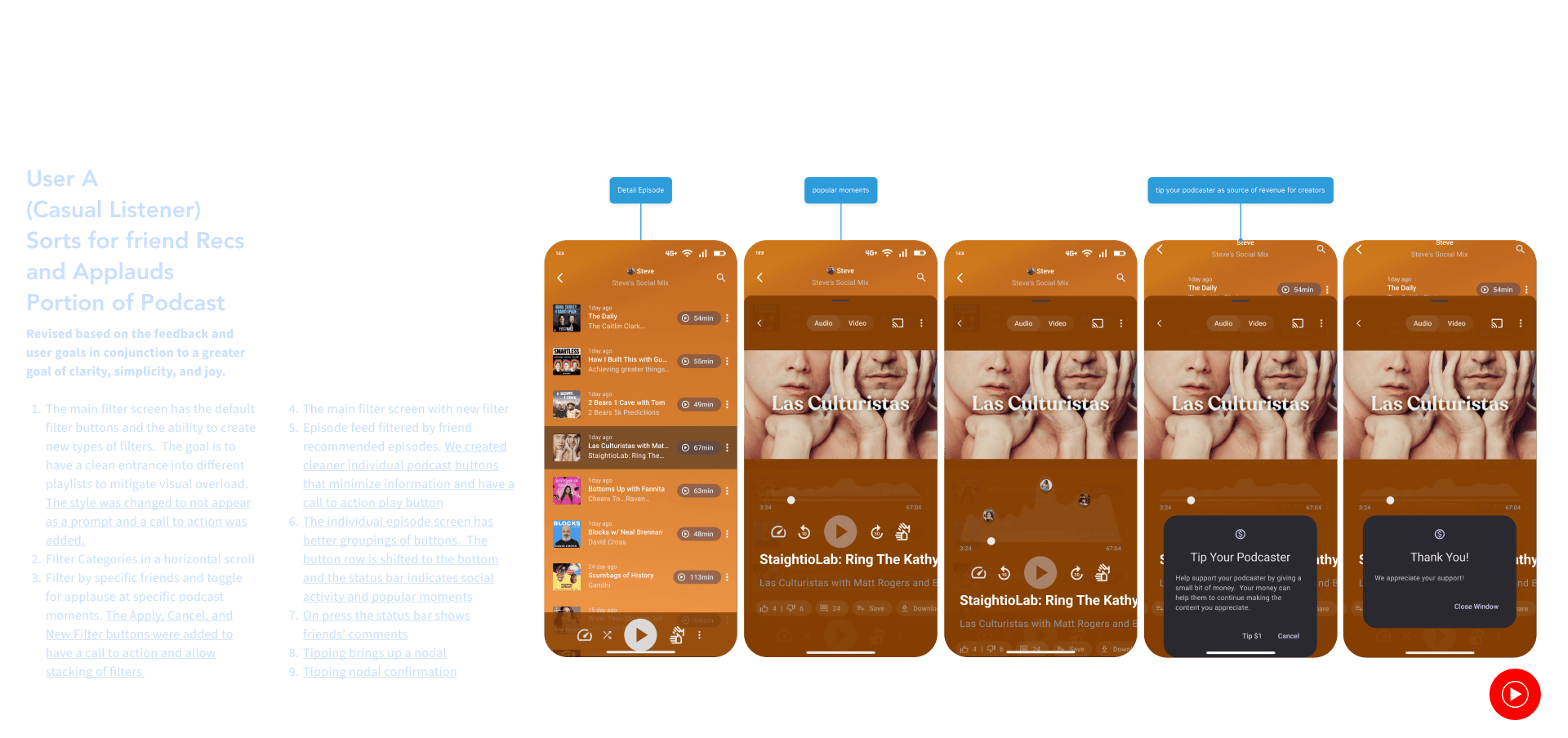
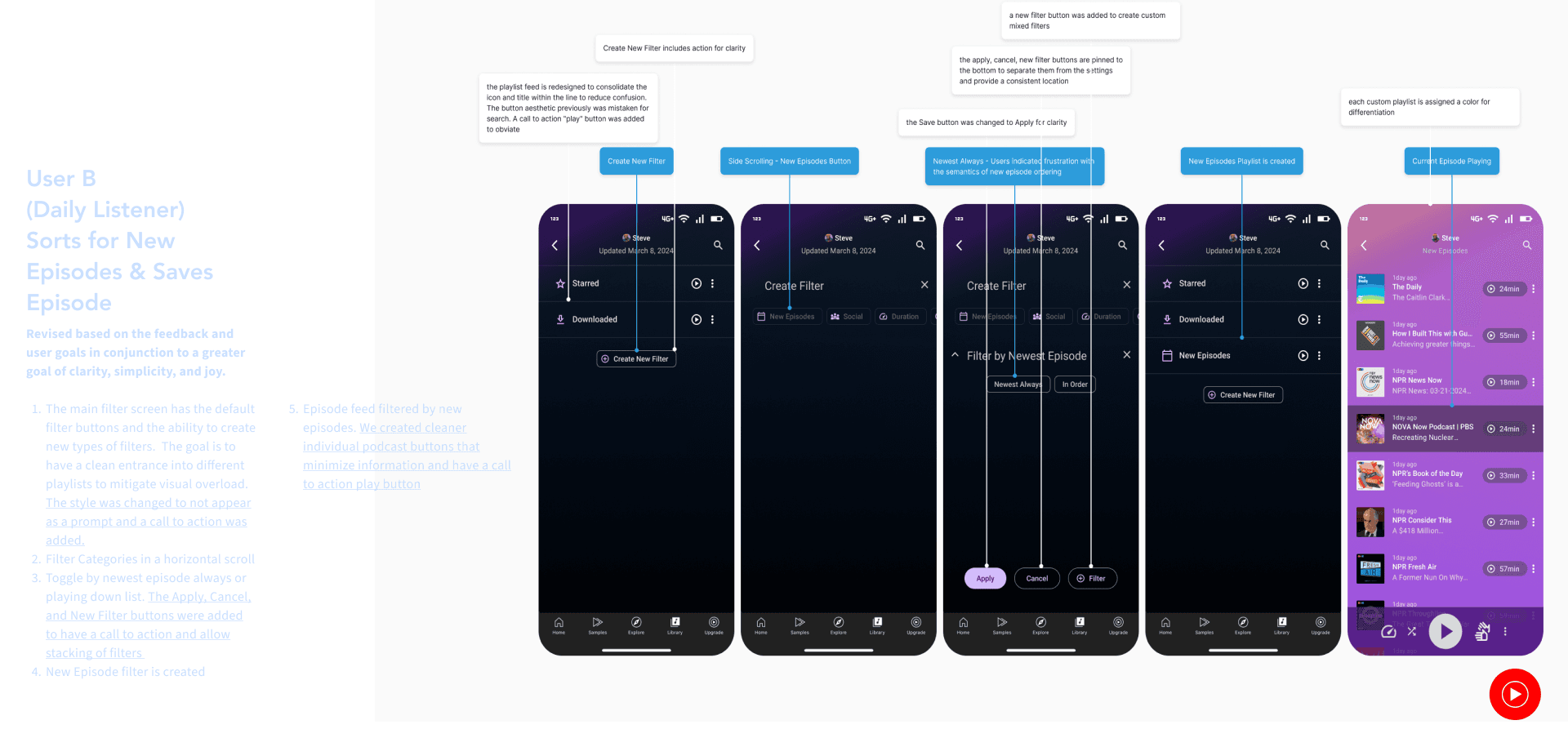
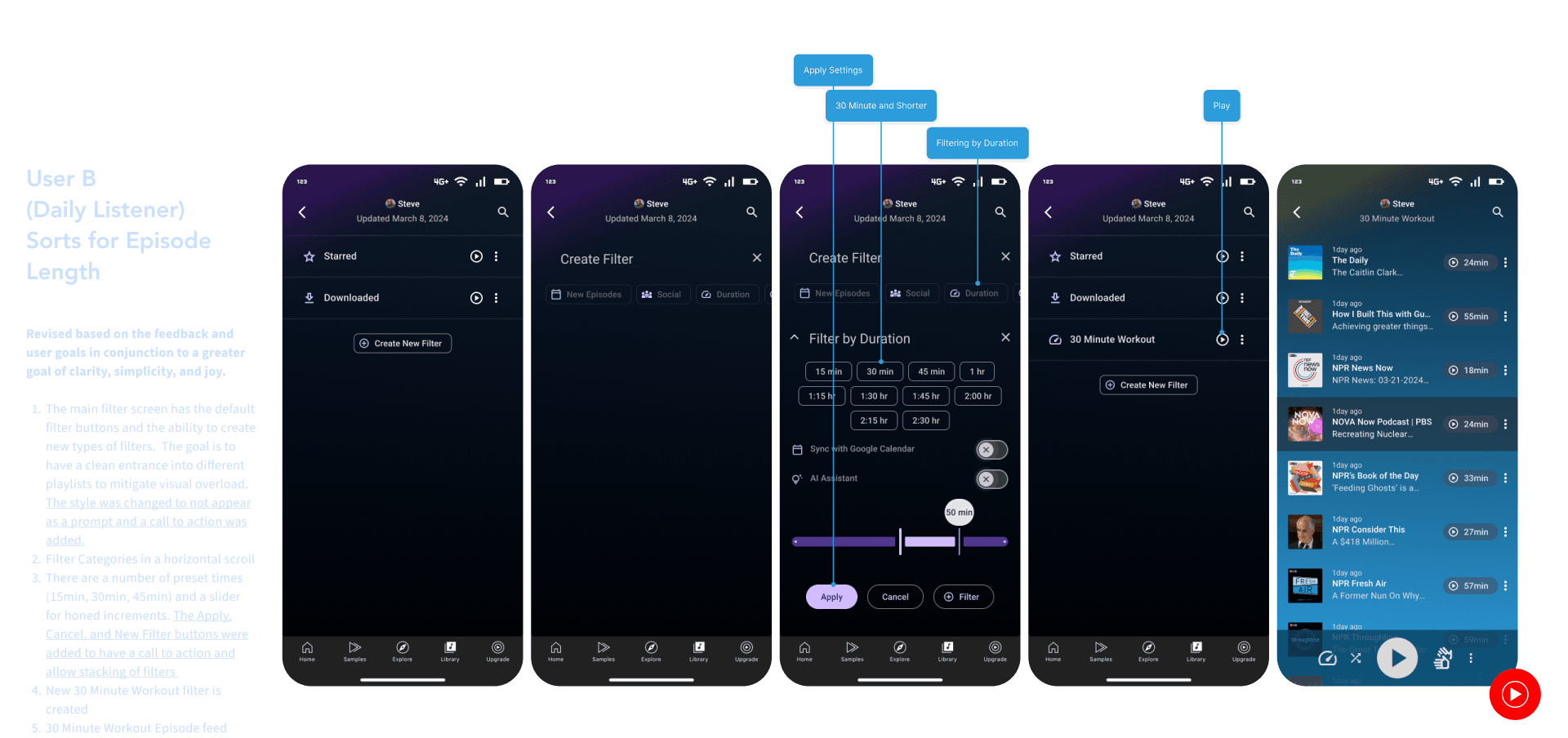
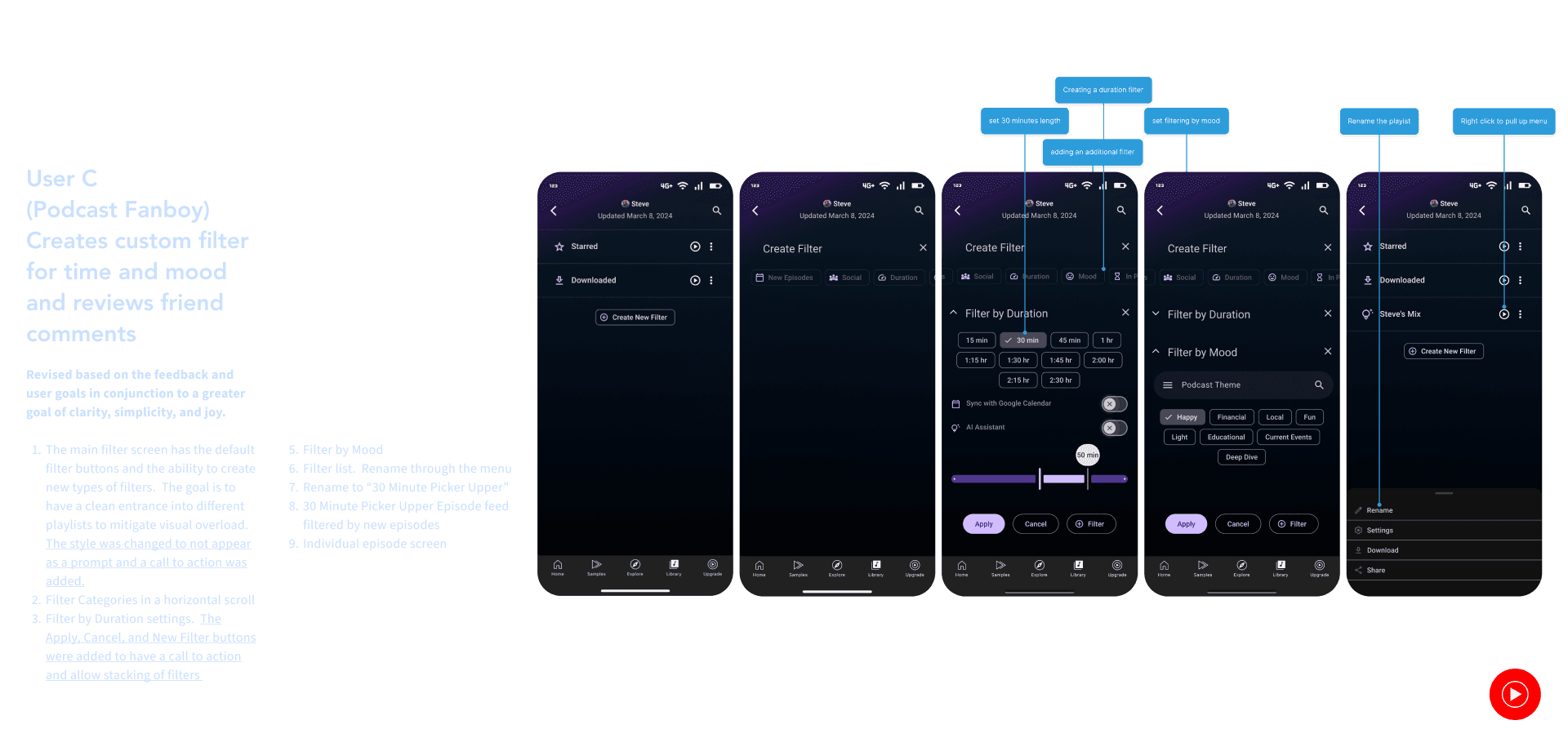
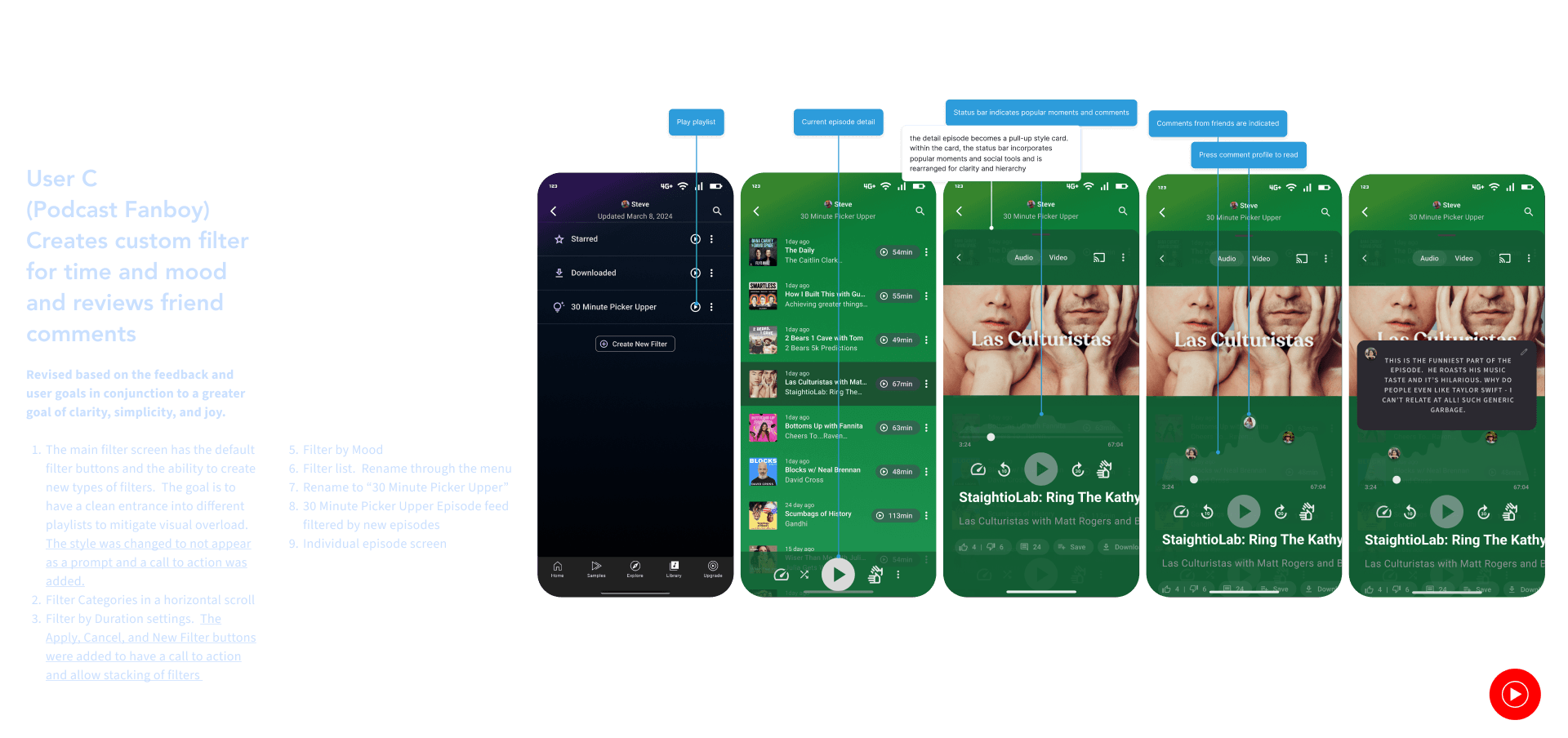
To user test we developed a prototype of the proposed podcasting feature. We proceeded to conduct usability testing sessions with participants to assess the intuitiveness, functionality, and overall user experience. Afterward, we collected feedback on specific features, navigation, and any potential issues.
With a prototype in hand participants were asked to complete 4 taskflows while being observed. Participants were asked to think outloud in realtime while performing the tasks and reflect on their expectations. The amount of time and points of failure were denoted.
The culmination of this process is a product refined through posing the right questions to answer and testing the ideas even further.
The culmination of this process is a product refined through posing the right questions to answer and testing the ideas even further.
Achieved
The overall goal was to simplify the UI through custom filters. This project combined inspiration with user insights to create a new product.
Research helped to understand painpoints and grievances (see reddit comments & research) with existing podcasts platforms.
The goals were:
To work toward an overall goal of simplicity of a feed
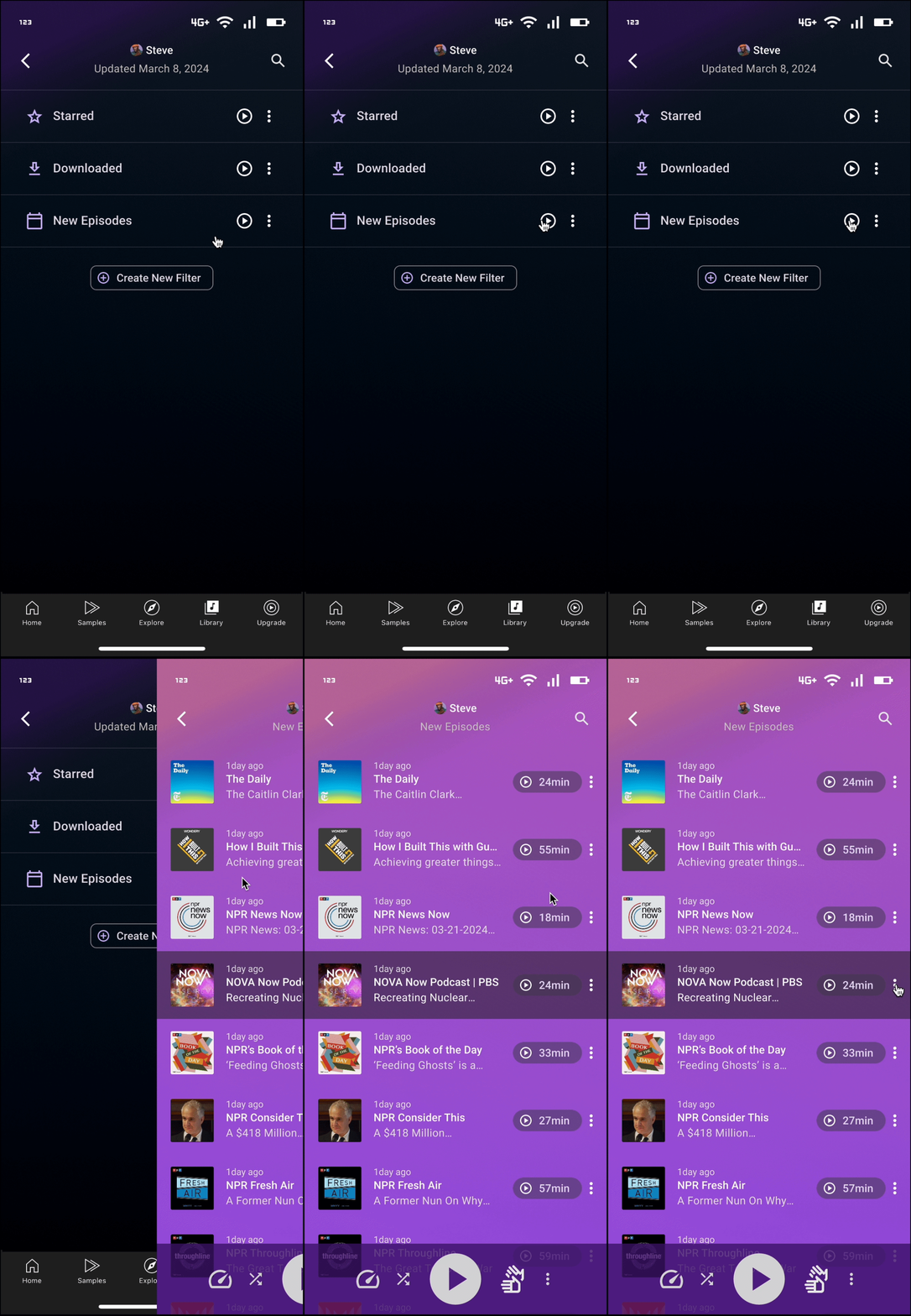
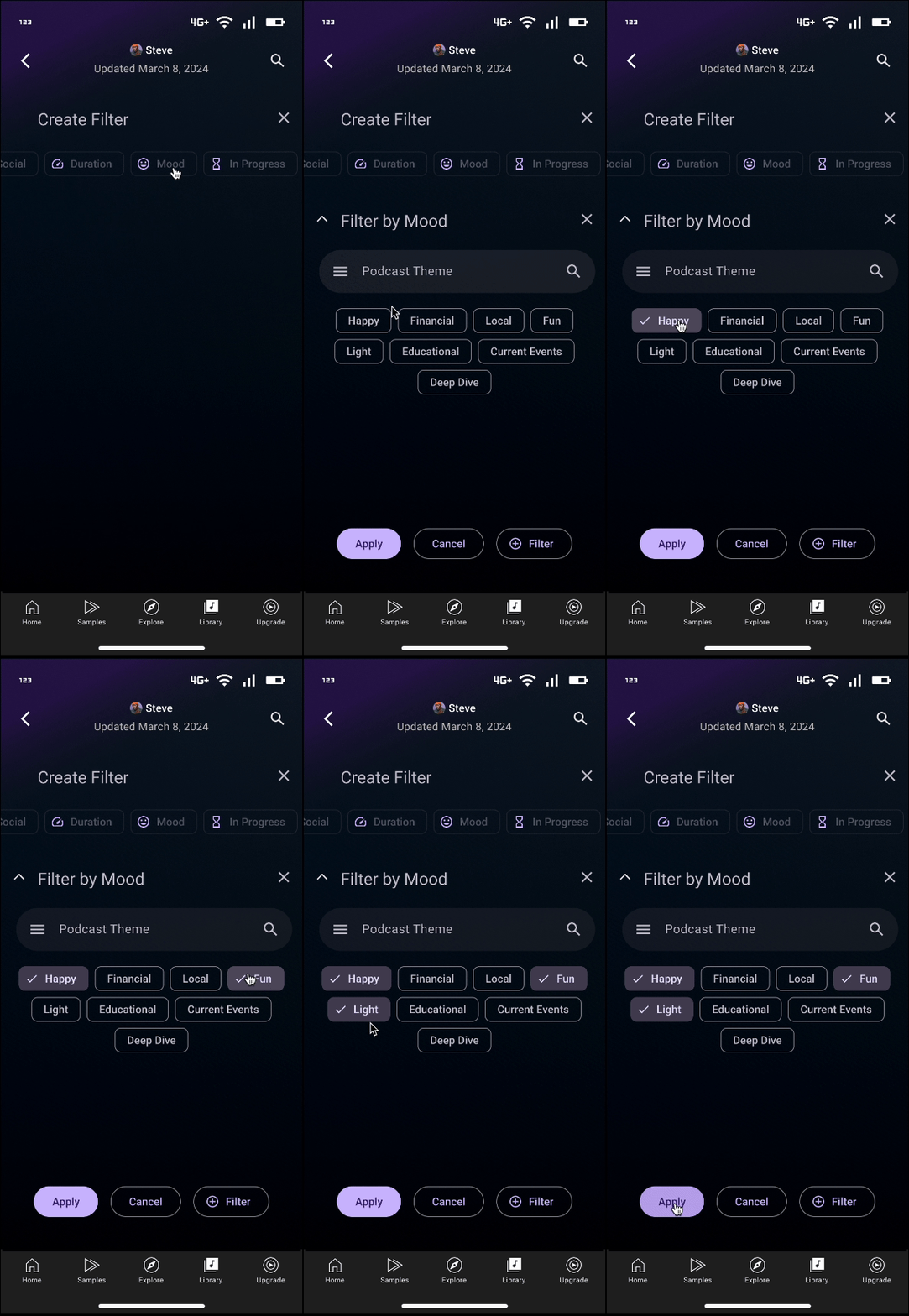
Custom filtered playlists for default settings for casual users and multiple custom filters for power users
Playlists by mood
Playlists by time increment & activity (coordinated with a calendar)
User research showed that users paired podcast listening with specific timed activities. I provided a filters for this as well as an opportunity to connect with google calendar.
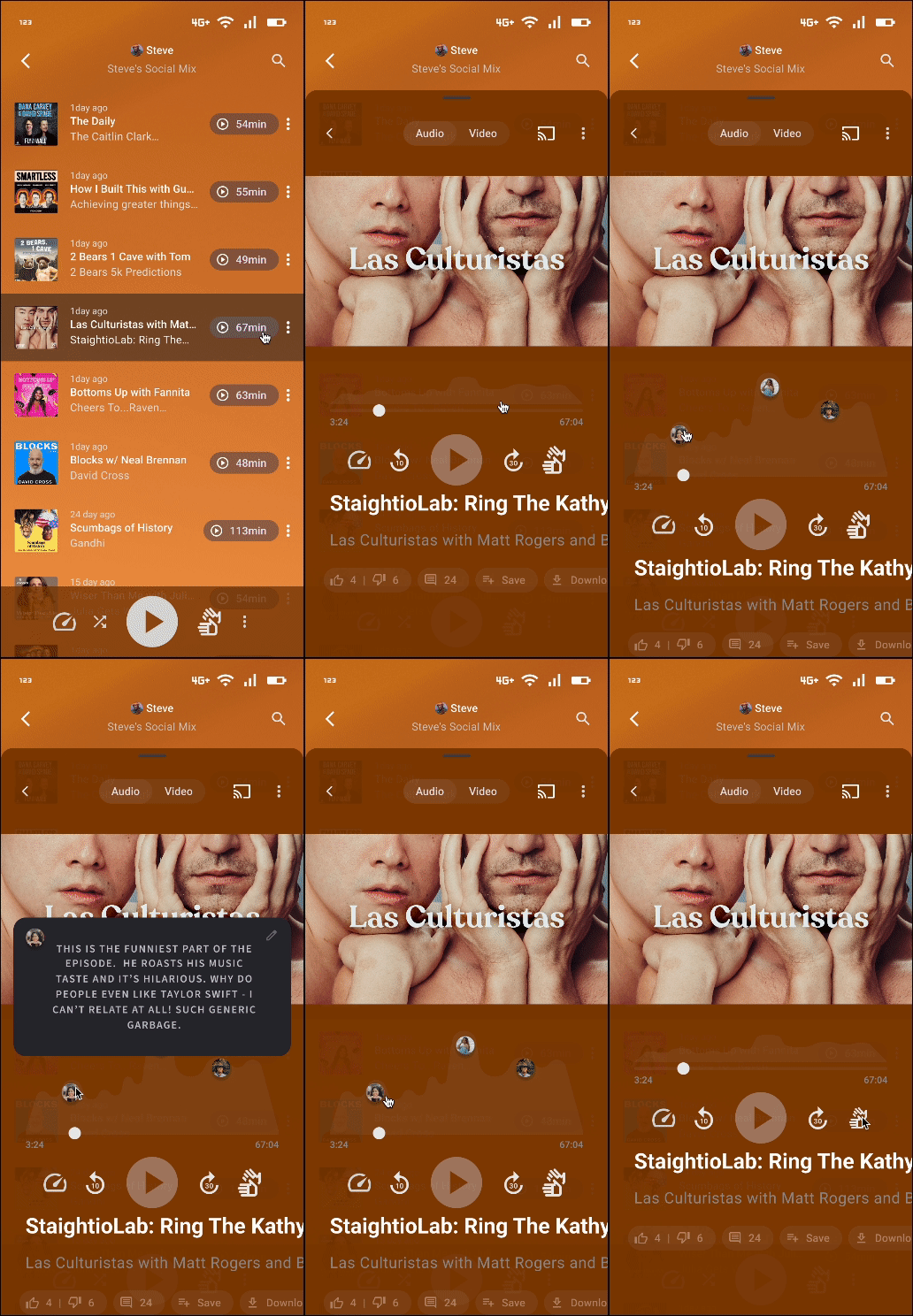
Playlists by friend recommendation
to introduce a soft social experience with selective friend recommendations and an "applause" system. Users had the desire to have community and a social experience without the baggage that entails. I create private and soft social experience with selective friend recommendations and an “applause” system that is simple to apply.
User research showed that users were drawn to the menu for most actions. The convenience of showing action buttons was creating clutter.
To create joy in color and interaction design
To address basic user frustrations
Users had frustrations with sort New Episodes across the board. I added additional settings and clearer language to address this issue.
To provide a monetization feature through tipping
Next Steps and Takeaways
There is difficulty in attempting to be subtly radical. Working on the existing YouTube Music product helped me realize that integrating numerous features and tools was counterproductive to creating a simple, minimal podcast player. Respecting established design patterns made this even more challenging. In the future, I would propose a deeper overhaul with the following goals in mind:
Push towards more simplicity like Google Podcasts
Further separation of music streaming and podcasts
Greater differentiation to compete with Spotify and Apple Music
Integration of YouTube’s assets and advantages (video)
Creation of different modes of podcast participation (e.g., a podcast-based book club).
Integration and opportunities in AI curation
Achieved
The overall goal was to simplify the UI through custom filters. This project combined inspiration with user insights to create a new product.
Research helped to understand painpoints and grievances (see reddit comments & research) with existing podcasts platforms.
The goals were:
To work toward an overall goal of simplicity of a feed
Custom filtered playlists for default settings for casual users and multiple custom filters for power users
Playlists by mood
Playlists by time increment & activity (coordinated with a calendar)
User research showed that users paired podcast listening with specific timed activities. I provided a filters for this as well as an opportunity to connect with google calendar.
Playlists by friend recommendation
to introduce a soft social experience with selective friend recommendations and an "applause" system. Users had the desire to have community and a social experience without the baggage that entails. I create private and soft social experience with selective friend recommendations and an “applause” system that is simple to apply.
User research showed that users were drawn to the menu for most actions. The convenience of showing action buttons was creating clutter.
To create joy in color and interaction design
To address basic user frustrations
Users had frustrations with sort New Episodes across the board. I added additional settings and clearer language to address this issue.
To provide a monetization feature through tipping
Next Steps and Takeaways
There is difficulty in attempting to be subtly radical. Working on the existing YouTube Music product helped me realize that integrating numerous features and tools was counterproductive to creating a simple, minimal podcast player. Respecting established design patterns made this even more challenging. In the future, I would propose a deeper overhaul with the following goals in mind:
Push towards more simplicity like Google Podcasts
Further separation of music streaming and podcasts
Greater differentiation to compete with Spotify and Apple Music
Integration of YouTube’s assets and advantages (video)
Creation of different modes of podcast participation (e.g., a podcast-based book club).
Integration and opportunities in AI curation